
AI tools for blockchain development fall into two distinct categories: tools that write, generate, or audit code, and the infrastructure that connects those tools to live chain data for agentic workflows — where an AI agent checks a wallet balance or reads a contract’s state instead of only suggesting text. This guide ranks the best tools in the first category, then compares the node providers that support the second, since a coding assistant is only as useful as the chain data it can actually reach.
Every entry below is judged on what it does today, not on roadmap promises, and each comparison includes where it still needs a human checking its work. Pricing, chain coverage, and client support all shift often in this space, so treat the specifics as a snapshot rather than a permanent ranking.
What Qualifies as an AI Development Tool for Web3?
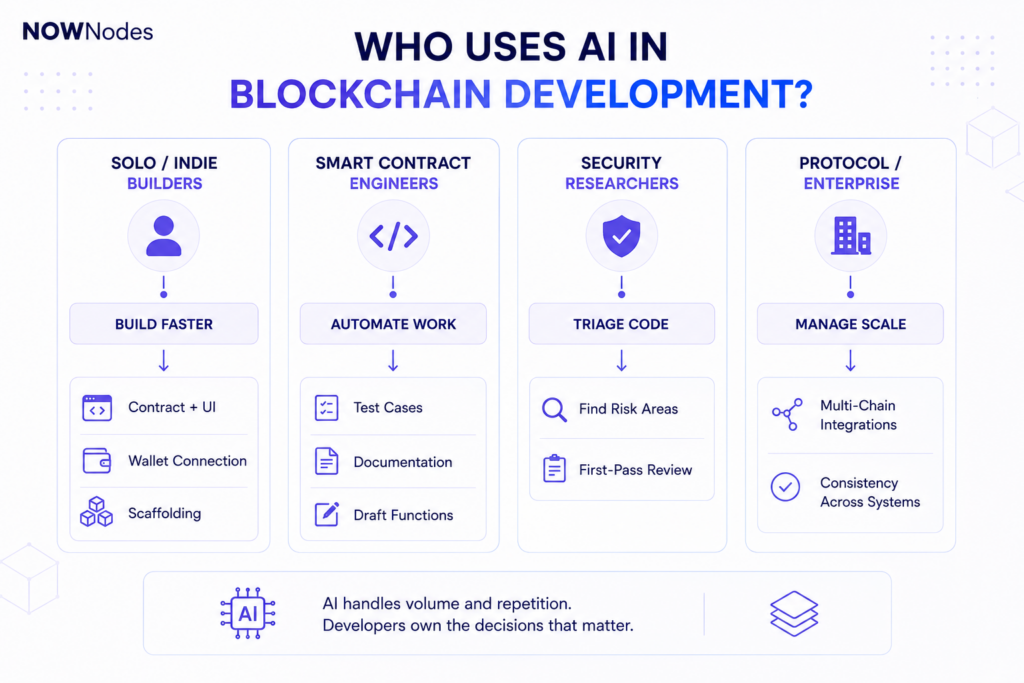
An AI coding tool for blockchain work is software built on a large language model (LLM) — a model trained to predict and generate text, including code, from a prompt — that reads, writes, or checks code for smart contracts, backend services, or the frontend connecting a wallet to both. Most of the tools on this list fall into that bucket.
A smaller, newer group goes further: agentic tools that execute a task themselves — running a test suite, deploying to a testnet, querying a contract’s live state — instead of only suggesting code a developer runs by hand. That distinction between writing code and acting on live chain data is why this guide covers two separate comparisons instead of one.
Why Developers Are Adopting Them
Developers reach for these tools because they remove time from the parts of coding that are necessary but not where the real thinking happens: boilerplate, repetitive tests, looking up a method signature. Across the industry, 84% of developers now use or plan to use AI tools, up from 76% the year before, and 51% use one daily, according to Stack Overflow’s 2025 Developer Survey.
Blockchain adds a second reason: the stack is unusually layered, spanning a smart contract, a backend that indexes chain data, a frontend wallet connection, and the infrastructure linking all of it to the network. An assistant that holds the whole codebase in context can catch a mismatch between layers that’s easy to miss when focused on just one.
The 7 Best AI Tools for Blockchain Development
| Tool | Type | Best For | Cost |
|---|---|---|---|
| Cursor | AI code editor | Whole-codebase context across a dApp | Free tier; Pro $20/mo |
| Claude Code | Agentic coding tool | Autonomous multi-step tasks, running tests | Pro $20/mo ($17 annual) |
| GitHub Copilot | AI pair programmer | Inline suggestions inside an existing IDE | Free tier; Pro $10/mo |
| ChainGPT | Contract generator + auditor | Fast Solidity scaffolding, first-pass audits | Free daily uses; pay-as-you-go |
| Remix AI | Built-in IDE assistant | End-to-end Solidity work in one place | Free tier; paid credits |
| Thirdweb Nebula | Onchain AI agent | Natural-language contract deployment | Free tier; usage-based |
| AI-paired static analyzers | Security tooling | Fast first-pass vulnerability scanning | Free, open-source |
1. Cursor
Cursor is a fork of VS Code built around AI from the ground up, reading a project’s full codebase for context rather than just the open file. For blockchain work, that means it can reference a project’s existing contracts, tests, and frontend code in the same suggestion — useful when a Solidity change needs a matching update in the JavaScript that calls it. The free Hobby tier has limited agent capability; Pro runs $20 a month with unlimited first-party model access, per current pricing data.
2. Claude Code
Claude Code is Anthropic’s terminal-based agentic coding tool, built to execute multi-step tasks rather than only suggest snippets — running a test suite, fixing a failing build, or working through a list of changes across several files in one session. That makes it a fit for the more mechanical parts of a blockchain workflow, like generating tests for a contract and iterating until they pass. The Pro plan runs $20 a month, or $17 with annual billing, using a rolling usage window rather than a flat generation cap.
3. GitHub Copilot
GitHub Copilot remains the most widely deployed AI pair programmer, built into nearly every major IDE rather than shipping as its own editor. Its blockchain-specific value is modest — it treats Solidity and Rust like any other language, without contract-aware auditing — but that ubiquity is the point: a team already paying for Copilot gets Solidity support for free rather than adopting a second tool. The free tier includes 2,000 completions a month; Pro costs $10.
4. ChainGPT
ChainGPT’s Smart Contract Generator and Auditor are the most blockchain-native tools on this list, in the sense that they do nothing else. The generator turns a plain-language description into a deployable Solidity contract across EVM chains including Ethereum, BNB Chain, and Arbitrum; the auditor scans pasted code for vulnerabilities, logic flaws, and gas inefficiencies and returns a severity-ranked report. Both tools give 10 free uses a day, then charge roughly a cent or two per use in credits.
5. Remix AI
Remix AI is built into Remix, the browser-based IDE most Solidity developers already use, which makes it the lowest-friction option here — there’s no separate tool to install. Beyond code generation and completion, it explains compiler errors, audits contracts using Slither scans across 47-plus security checklists, and suggests gas optimizations without leaving the editor. It also handles Vyper and general JavaScript/TypeScript work, and accepts a developer’s own Anthropic, OpenAI, or Mistral API key instead of Remix’s own billing.
6. Thirdweb Nebula
Thirdweb’s Nebula is a different kind of tool: an AI model built specifically to read, write, and reason about onchain data through conversation, rather than a code editor. A developer can ask it to deploy a contract, check a wallet’s holdings, or explain what a transaction did, and it handles the underlying calls. That focus on acting on-chain instead of editing files is the clearest real-world example of the agentic category described earlier.
7. AI-Paired Static Analyzers
The seventh entry isn’t one product — it’s a pattern. Open-source static analyzers like Slither and Mythril have scanned Solidity for known vulnerability patterns for years; what’s changed is that an LLM increasingly sits next to the scanner, translating a flagged issue like “reentrancy in function X” into a plain-language explanation of the actual risk and a suggested fix. Several tools above, including Remix AI, build this pairing directly into their own audit features rather than leaving a developer to interpret a scanner’s raw output alone.
Which Blockchain Infrastructure Providers Support AI Coding Tools?
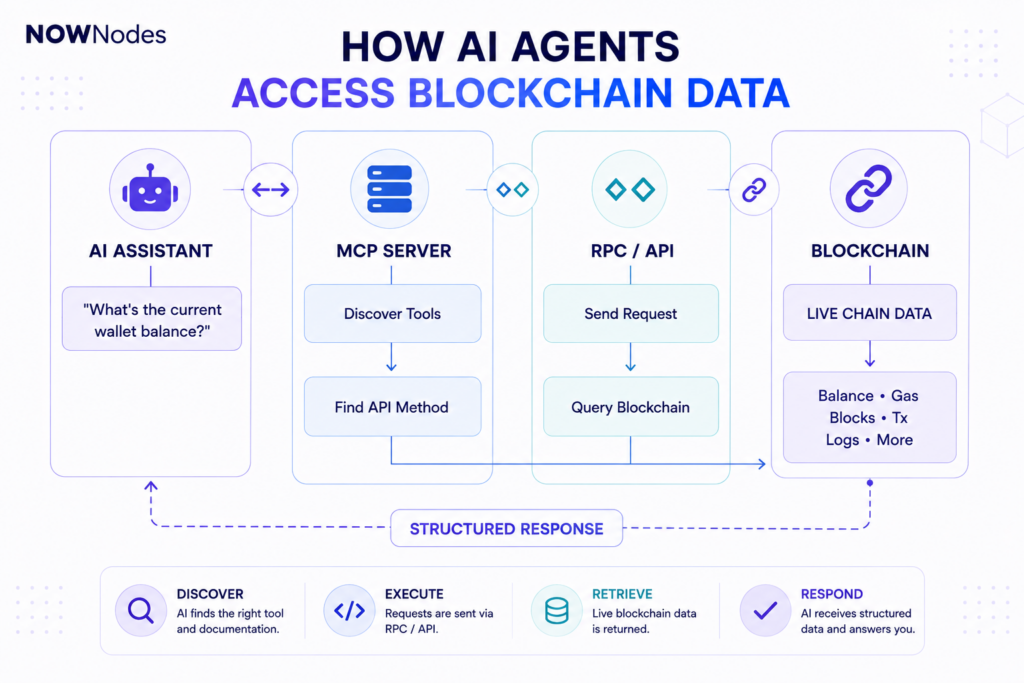
None of the tools above can act on live chain data by themselves — an LLM’s training data has a cutoff date, so it has no idea what a wallet’s balance is right now or what gas costs on Ethereum look like this minute. That connection runs through an RPC (Remote Procedure Call) endpoint: a server that lets software query blockchain data and broadcast signed transactions.
Model Context Protocol (MCP): an open standard, introduced by Anthropic in November 2024, that lets an AI assistant discover and call external tools and data sources — including blockchain APIs — through a common interface, without a developer hand-building custom integration code for every model and every chain. See the official MCP documentation.
Most major node providers now ship an MCP server for this exact reason. The table below compares what’s actually documented as of this writing, since client support and chain coverage change often.
| Provider | AI clients supported | Chain coverage | Notable detail |
|---|---|---|---|
| NOWNodes | Claude Desktop, Claude Code, Cursor, VS Code, Windsurf, Codex | 120+ networks | Generates ready-to-run curl, JavaScript, and Python requests; setup takes about a minute |
| Chainstack | Claude Code, Cursor, Codex, Windsurf, Gemini CLI, GitHub Copilot, ChatGPT, and more | 70+ chains beyond majors | No install — runs as a remote server; SOC 2 Type II compliance |
| QuickNode | Claude Desktop, Claude Code, Cursor, VS Code, Windsurf, Zed | Every network QuickNode supports | Also manages billing, usage analytics, and endpoint security via natural language |
| Alchemy | Claude, Cursor, Codex, ChatGPT, VS Code Copilot, Claude Desktop | 100+ chains | 168 tools across its API surface; serves 100M+ users |
| Infura | None official | — | Only unofficial, community-built MCP servers exist on GitHub |
A few honest distinctions are worth drawing out. NOWNodes and Alchemy both publish 100-plus-network coverage, ahead of what Chainstack states outright, while Chainstack supports the widest range of AI clients, including ChatGPT and GitHub Copilot directly rather than just Claude- and Cursor-family tools. Infura is the clearest gap: no official MCP server as of this writing, so a developer wanting that integration has to trust a third-party GitHub project instead of the provider’s own infrastructure.
NOWNodes’ MCP Server works by supplying structured, documentation-backed context for building a request — looking up the right API method, generating a working call, and providing authentication guidance from inside a chat window — rather than handing the AI autonomous control over a wallet or a chain. That distinction applies to every provider in the table above: an MCP server makes the right API call easier to construct. It doesn’t remove the need to review what the call actually does before running it against mainnet.
Where Does Machine-Generated Code Still Fall Short?
The short answer: security and business logic, the two things blockchain development can least afford to get wrong. A 2025 academic assessment of Solidity contracts generated by GPT-4 found that among contracts that compiled successfully, roughly 29% contained at least one security vulnerability; contracts from a specialized coding model were vulnerable in nearly 69% of cases, per the study’s published results. Reentrancy — a bug that lets an attacker call back into a contract before its first transaction finishes, draining funds in a loop — was the single most common issue in both.
Developers sense this gap even outside blockchain. Only 3.1% say they “highly trust” AI-generated code’s accuracy, while 45.7% actively distrust it, per the same Stack Overflow survey cited earlier. The top complaint, named by 66% of respondents, is AI output that’s “almost right, but not quite” — the kind of subtle wrongness that’s easy to miss in review and expensive to miss in a deployed contract.
There’s a useful nuance in the loss data: access-control failures, not code-logic bugs, are tied to roughly $953 million of the $1.42 billion in documented 2025 smart contract losses tracked by the OWASP Smart Contract Top 10. The category of mistake AI is worst at catching — who’s allowed to call a function, and under what conditions — is also the one causing the most damage.
Can AI Replace a Security Audit?
No — not for anything holding meaningful value. AI and static analysis are good at flagging known vulnerability patterns fast and cheaply, which is why they’ve become a standard first pass, including inside tools like Remix AI and ChainGPT above. What they can’t yet do reliably is reason about a protocol’s specific business rules the way an experienced human auditor does, or account for off-chain risks like a stolen private key.
Ethereum co-founder Vitalik Buterin has framed this as teamwork rather than replacement. Responding in May 2026 to fears that AI would make writing secure code impossible, he wrote:
“Many claim that with AI-assisted vulnerability detection, writing secure code will become impossible. But I remain optimistic, and AI-assisted formal verification is one reason why.” — Vitalik Buterin, Ethereum co-founder, via KuCoin, May 2026
His point is specifically about AI paired with formal verification — mathematically proving code matches a specification — not AI writing contracts unsupervised. For anything holding real value, that still means a professional review; see this breakdown of smart contract auditing firms for how that process works.
How Do You Test AI-Written Code Safely?
Start on a testnet, not mainnet. A testnet is a separate blockchain environment that mirrors the real network’s rules without using real funds, which makes it the right place to find out whether AI-generated code actually does what it was asked to do. A few habits make that testing phase worth the time it takes:
- Fund the testnet wallet through a faucet, not with real assets, so a mistake costs nothing.
- Run the test suite against real block times and gas costs, not just a local simulation, since some bugs only show up under real network conditions.
- Feed it edge cases the AI didn’t think of — a zero-value transfer, a reentrant call, an unexpected sender — since generated tests tend to cover the happy path more thoroughly than the adversarial one.
- Compare gas usage against a hand-written equivalent, if one exists, since AI-generated code isn’t always optimized for cost.
None of this replaces a professional audit for a contract that will hold user funds. It just means whatever reaches the auditor’s desk has already had its obvious problems removed.
How to Choose the Right Tool for Your Project
Matching a tool to the job matters more than picking the “best” one on the list above. A team already paying for GitHub Copilot across its whole stack gets Solidity support for free by using it there, rather than adding Cursor or Claude Code on top. A solo developer scaffolding a first contract gets more direct value from ChainGPT or Remix AI, since both are built around blockchain specifically instead of general-purpose code.
For anything that needs to read live chain state — a bot, an agent, a dashboard — the infrastructure question comes first: check which of the providers above actually supports the AI client already in use before assuming any of them work out of the box. Regardless of which tool writes the first draft, the review step described above doesn’t get to shrink just because the code compiled cleanly.
Conclusion
The best AI tool for blockchain development depends on what’s missing from a workflow today: Cursor and Claude Code cover general coding speed, ChainGPT and Remix AI cover blockchain-specific scaffolding and first-pass audits, and an MCP-enabled provider covers the live data an agent needs to act rather than just suggest. Most serious setups end up combining more than one.
What doesn’t change across any of them is the review step. Use these tools to scaffold, test, and get a fast first read on a codebase — they’re genuinely good at that. Keep a human, and eventually a professional auditor, on anything that touches real funds, because that’s exactly where today’s tools are still most likely to be confidently wrong.
FAQ
Is Cursor or Claude Code better for blockchain development?
Neither is built specifically for blockchain, so the difference comes down to workflow. Cursor’s strength is holding a whole project’s context while coding interactively inside an editor; Claude Code’s strength is executing a defined task end to end, like writing and running tests until they pass, with less back-and-forth. Many developers use both for different parts of the same project.
Which of these AI tools is free to start with?
Most are. GitHub Copilot, Cursor, Remix AI, ChainGPT, and Thirdweb Nebula all offer a free tier or a daily free allotment, and the static analyzers behind category seven are open-source. Claude Code’s pricing starts at $20 a month in current breakdowns, with no separate free tier — worth confirming directly, since plans change.
Do I still need to learn Solidity if I use AI coding tools?
Yes. These tools remove typing and boilerplate, not the need to understand what the code does — you still have to read and verify what gets generated. Treat any of them as a way to write Solidity faster, not a substitute for learning it.
Can AI help optimize gas costs, not just write correct code?
Yes — it’s one of the more mature use cases, and several tools above (Remix AI and ChainGPT specifically) build it in directly. They can suggest cheaper storage patterns and compare gas costs against common alternatives, though a human still needs to confirm the change doesn’t alter the contract’s behavior.
Does using AI tools change how much a blockchain project costs to build?
It typically lowers the time cost of early development, since scaffolding, tests, and documentation take less human time. It doesn’t reduce the cost of security — audits and testnet cycles still need the same budget, since that’s where AI contributes the least.