
A modular blockchain hands off one or more of its core jobs — execution, settlement, consensus, or data availability — to a separate specialized chain instead of doing everything itself. A monolithic blockchain keeps all four of those jobs on a single layer. That split is the whole disagreement: one design spreads the work out, the other keeps it in-house.
Neither approach is new by accident. Both grew out of the same constraint, which says a chain can’t max out decentralization, security, and speed all at once without help. Modular blockchains and monolithic blockchains are two different answers to that same limit, not two versions of the same idea.
Here’s modular vs. monolithic blockchains explained from the basics up: what each term actually means, why the split happened, who builds on which model, and where the trade-offs actually bite in 2026.
What Is a Modular Blockchain?
A modular blockchain is a chain built to do one or two jobs well and outsource the rest. Instead of one network handling transaction execution, ordering, data storage, and dispute resolution all by itself, those jobs get split across two or more purpose-built chains that plug into each other.
Modular blockchain: a blockchain architecture that separates a network’s core functions — execution, settlement, consensus, and data availability — across multiple specialized layers instead of running them on one chain. See Celestia’s glossary definition.
Ethereum’s rollups are the clearest working example. Arbitrum and Base execute transactions off-chain, then post the results back to Ethereum, which handles consensus and data availability on their behalf. Neither rollup runs its own validator set from scratch — that’s the point.
How a Modular Stack Actually Works
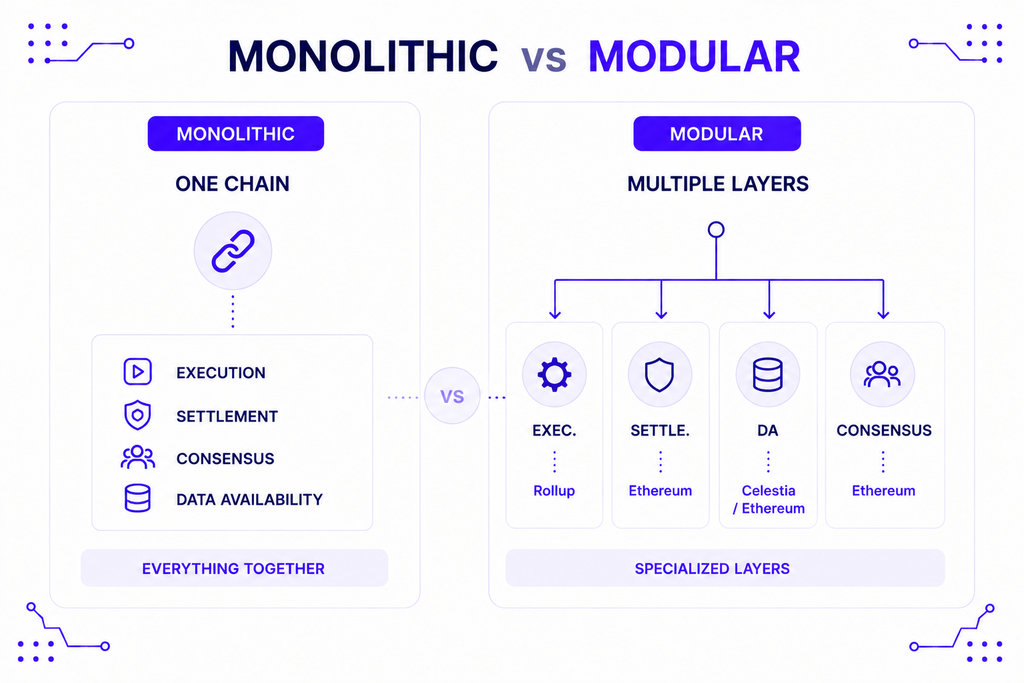
Every blockchain, modular or not, performs four functions somewhere. A modular design just spreads them across different chains rather than bundling them into one:
| Function | What it does | Typical modular example |
|---|---|---|
| Execution | Runs transactions and updates account state | Arbitrum, Base, Optimism |
| Settlement | Verifies proofs and resolves disputes between layers | Ethereum L1 |
| Consensus | Orders transactions and finalizes blocks | Ethereum L1, Celestia |
| Data availability | Publishes transaction data so anyone can verify it | Celestia, EigenDA, Ethereum blobs |
A rollup, for instance, only handles execution. It leans on Ethereum for settlement and consensus, and depending on its design, either posts data back to Ethereum as a blob or to a dedicated data availability network such as Celestia or EigenDA instead.
What Is a Monolithic Blockchain?
A monolithic blockchain runs execution, settlement, consensus, and data availability on one layer, with one validator set checking all of it. Bitcoin and Solana are the two clearest examples — neither hands any of its core jobs to a separate chain.
Monolithic blockchain: a blockchain that performs all core network functions — execution, consensus, settlement, and data availability — within a single, self-contained layer. See ethereum.org’s rollup-centric roadmap explainer for how this contrasts with Ethereum’s own design.
That single-layer approach isn’t a design flaw — it’s a deliberate bet on simplicity. Every transaction gets validated, ordered, and stored by the same set of nodes, which keeps the trust model straightforward: there’s no second chain to also verify, no bridge between layers to secure.
Why Some Teams Stay Monolithic on Purpose
Solana is the sharpest example of this bet paying off in raw throughput. It sustains roughly 1,500 to 1,900 transactions per second in real-world use, with a theoretical ceiling near 65,000, according to CoinLaw’s 2026 network data — all without splitting execution off to a second chain.
Solana co-founder Anatoly Yakovenko has been blunt about why staying monolithic still matters to him, even as modular L2s multiply around Ethereum. Asked what keeps Solana ahead of newer, similarly fast chains, he put it in five words: “Execution is the only moat, always,” he said, as reported by Blockworks — a bet that shipping fast on one integrated chain beats coordinating across several specialized ones.
Why Did Blockchains Split Into Layers in the First Place?
The short answer is the trilemma. A single chain trying to handle everything at once hits a hard ceiling: more nodes checking more data makes the network slower, and speeding it up usually means fewer, more powerful nodes doing the checking.
Ethereum’s base layer settles around 26 transactions per second on its own — nowhere near enough for a busy consumer app, and raising that number the naive way would price out ordinary node operators. Rollups solved the execution side of that problem years ago by moving computation off-chain, but they still needed somewhere cheap and trustworthy to publish their data.
That’s the gap danksharding and dedicated data availability networks exist to close. Splitting the data-availability job off from execution let Ethereum’s blob capacity grow to a target of 14 and a maximum of 21 blobs per block without touching the base layer’s validator set, according to ethereum.org’s roadmap — a scaling gain that came specifically from specializing, not from a single chain getting faster on its own.
Who Actually Builds on Each Model?
The two designs attract genuinely different builders, and the split usually comes down to what a project needs most: control over its own execution environment, or a chain that already does everything for it.
Modular: Rollup Teams and App-Specific Chains
Rollup teams — Arbitrum, Optimism, Base, zkSync — are the most visible modular builders, since each one specializes in execution while leaning on Ethereum or a dedicated data availability layer for the rest. As of 2026, Celestia alone provides data availability to 11-plus rollups and app-chains, including Manta Pacific, Orderly Network, and Eclipse, according to L2Beat’s data availability summary.
Gaming studios and DeFi protocols that want their own dedicated blockspace also lean modular, since spinning up an app-specific rollup is cheaper than launching a standalone chain with its own validator set. They get a chain tuned to their app’s needs without having to bootstrap consensus and data availability from zero.
Monolithic: High-Throughput Chains and Simplicity-First Projects
Bitcoin and Solana anchor the monolithic side for very different reasons. Bitcoin never split its functions apart because its design goal was never raw throughput — it settles around 7 transactions per second by choice, prioritizing decentralization and security over speed.
Solana went the opposite direction on the same monolithic model: instead of outsourcing execution, it optimized the single layer itself, using parallel transaction processing to push throughput up without adding a second chain. Teams building high-frequency trading apps, games, or anything latency-sensitive often prefer that model, since one integrated chain means no cross-layer delay between execution and finality.
Modular vs. Monolithic: Comparing the Trade-Offs
Put side by side, the two designs trade predictable strengths for predictable weaknesses. Neither wins outright — each optimizes for a different constraint.
| Factor | Modular blockchains | Monolithic blockchains |
|---|---|---|
| Scalability | Higher — each layer scales independently | Capped by the single layer’s hardware limits |
| Security model | Depends on the settlement/DA layer it plugs into | Self-contained, enforced by one validator set |
| Complexity | More moving parts, more bridges to secure | Simpler — one chain, one set of rules |
| Composability | Fragmented across rollups unless bridged | Native — everything lives in one state |
| Data availability | $787M total value secured across alt-DAs like Celestia and EigenDA | Handled internally by the base chain |
| Examples | Arbitrum, Base, Optimism, Celestia | Bitcoin, Solana |
Ethereum’s own base layer still secures roughly $33.17 billion in data availability value versus $787 million across every alternative DA layer combined, per L2Beat — a reminder that even the biggest modular ecosystem still runs mostly through one settlement layer, not a fully decentralized patchwork.
How to Choose Between the Two Architectures
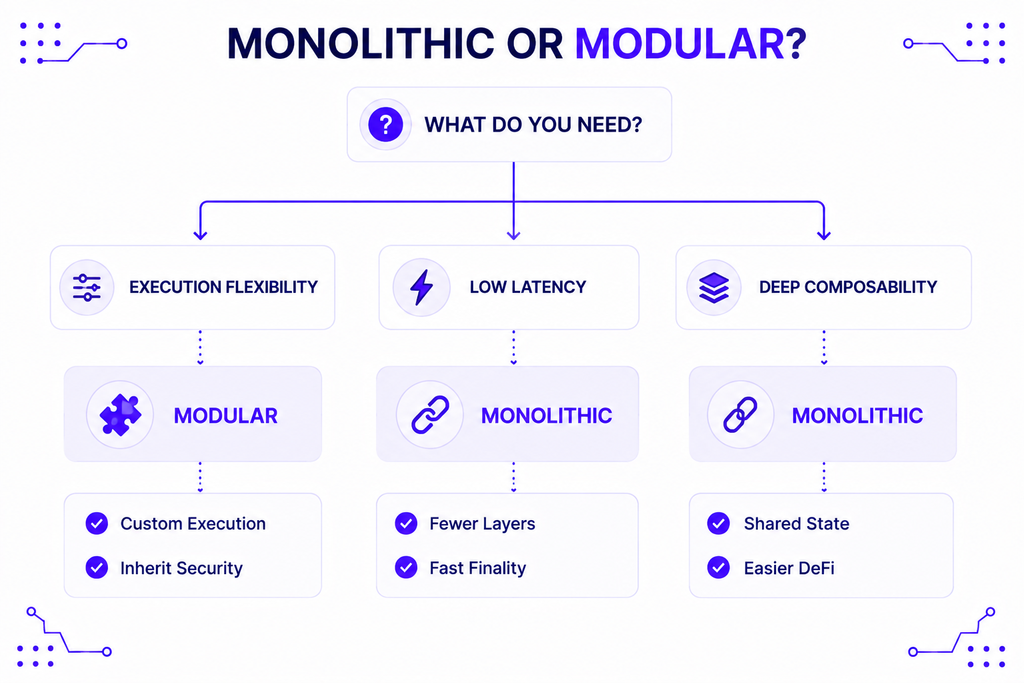
Neither model is objectively better, so the real question is what a specific project actually needs to optimize for. A few practical signals point one way or the other.
- Need execution flexibility without building consensus from scratch? A modular rollup lets a team launch its own execution environment while inheriting security from an established settlement layer.
- Need the fastest possible finality with the fewest moving parts? A monolithic chain skips the cross-layer communication a modular stack requires, which matters for latency-sensitive applications.
- Building something that needs deep composability with existing DeFi? Monolithic chains and Ethereum’s own base layer keep state in one place, which is simpler to compose against than a rollup that has to bridge assets in and out.
- Expecting to scale far beyond a single chain’s ceiling? Modular architecture lets execution, data availability, and settlement each scale on their own schedule instead of waiting for one chain to catch up.
Where Node Infrastructure Fits Into Either Model
Both architectures still need the same basic thing: reliable access to on-chain data. A modular rollup needs RPC access to its own execution layer and to whatever settlement chain it posts to; a monolithic chain needs the same access to a single, larger dataset instead.
That’s an infrastructure problem regardless of which model a team picks, and it doesn’t go away just because a chain is modular or monolithic. NOWNodes, for instance, provides RPC access across 120-plus networks — covering monolithic chains like Bitcoin and Solana alongside modular rollups such as Arbitrum and Optimism — so a team building across both models doesn’t need to run separate node infrastructure for each one.
Conclusion
Modular and monolithic blockchains are two answers to the same constraint, not two stages of the same evolution. A modular design spreads execution, settlement, consensus, and data availability across specialized chains to scale each one independently; a monolithic design keeps all four on one layer to stay simple and self-contained.
Which one fits depends on what a project is actually optimizing for — flexibility and independent scaling favor a modular rollup, while raw speed and composability favor a monolithic chain. Ethereum’s own trajectory shows both can coexist: its base layer stays largely monolithic in function while an entire modular ecosystem of rollups builds on top of it.
FAQ
Is Ethereum modular or monolithic?
Ethereum’s base layer still handles consensus, settlement, and (partly) data availability itself, but its scaling strategy is explicitly modular — it outsources execution to rollups like Arbitrum and Base rather than processing everything on layer 1.
Is Solana a modular blockchain?
No. Solana is monolithic — it processes execution, consensus, and data availability on a single layer using parallel transaction processing, rather than splitting those jobs across separate chains.
Do modular blockchains have their own security, or do they borrow it?
It depends on the layer. A rollup that settles to Ethereum inherits Ethereum’s security for settlement, but its data availability layer — whether Ethereum blobs, Celestia, or EigenDA — has its own separate security assumptions that don’t automatically match the settlement layer’s.
Are modular blockchains always more scalable than monolithic ones?
Not automatically. Modular architecture raises the ceiling on total throughput because each layer can scale independently, but a monolithic chain like Solana can still outperform a poorly optimized modular stack in raw transactions per second.
Can a blockchain switch from monolithic to modular later?
Not without a fundamental redesign. A chain built as monolithic would need to re-architect how it handles execution, settlement, and data availability to adopt a modular structure — Ethereum’s shift toward a rollup-centric roadmap took years of protocol changes, not a single upgrade.