
A zero-knowledge rollup, or ZK-rollup, is a Layer-2 network that moves Ethereum transactions off the main chain, bundles them together, and proves the whole batch is correct with math instead of asking anyone to trust the result. That proof — not a delay, not a vote, not an operator’s word — is what lets Ethereum accept the new state as final. It’s also why the term shows up written a dozen different ways — zk-rollup, zk rollup, zkrollup, zero knowledge rollup, ZK L2, or just “a zk” — all pointing at the same mechanism.
The idea sounds abstract until you see what it fixes. Ethereum’s base layer processes around 26 transactions per second, and every fee spike traces back to that ceiling. Below is zk rollups explained the way 2026 actually looks: what a ZK-rollup does, why it exists, who’s really building on one, and — since the space retired several of its own pioneers this year — what’s changed since most explainers were written.
What Does a Zero-Knowledge Proof Actually Do?
Strip away the cryptography and a ZK-rollup is doing one job: convincing Ethereum that a batch of off-chain transactions was executed correctly, without Ethereum having to re-run any of them itself. A specialized piece of software called a prover takes the batch, runs it through a proving system, and outputs a compact proof — typically a zk-SNARK or zk-STARK — small enough for a smart contract on Ethereum to check in a single step.
Validity proof: a cryptographic proof, generated off-chain, that mathematically demonstrates a rollup’s batch of transactions was executed correctly, verified by a smart contract on Ethereum in one step. See .
Here’s the part that trips people up: “zero-knowledge” describes the proof, not secrecy. Most zk-rollups, including zkSync Era and Starknet, still publish full transaction data to Ethereum so anyone can reconstruct account balances independently. The proof confirms the computation was right without re-running it, which is a different thing entirely from hiding what happened — for the deeper mechanics of how that proof gets built and checked, NOWNodes’ comparison of validity and fraud proofs walks through it step by step.
In practice, a transaction’s path looks like this:
- A user submits a transaction to the rollup’s sequencer instead of directly to Ethereum.
- The sequencer batches it with thousands of others and hands the batch to a prover.
- The prover generates a validity proof for the entire batch.
- A smart contract on Ethereum verifies the proof and finalizes the new state, usually within minutes to a few hours.
Why Did Ethereum Need This Kind of Scaling?
Ethereum’s base layer settles roughly 26 transactions per second, a ceiling that comes from asking every node to re-execute every transaction. Push that number up by simply demanding bigger blocks, and fewer people can afford the hardware to keep validating — the exact trade-off described by the blockchain trilemma: more throughput costs decentralization or security unless something else changes.
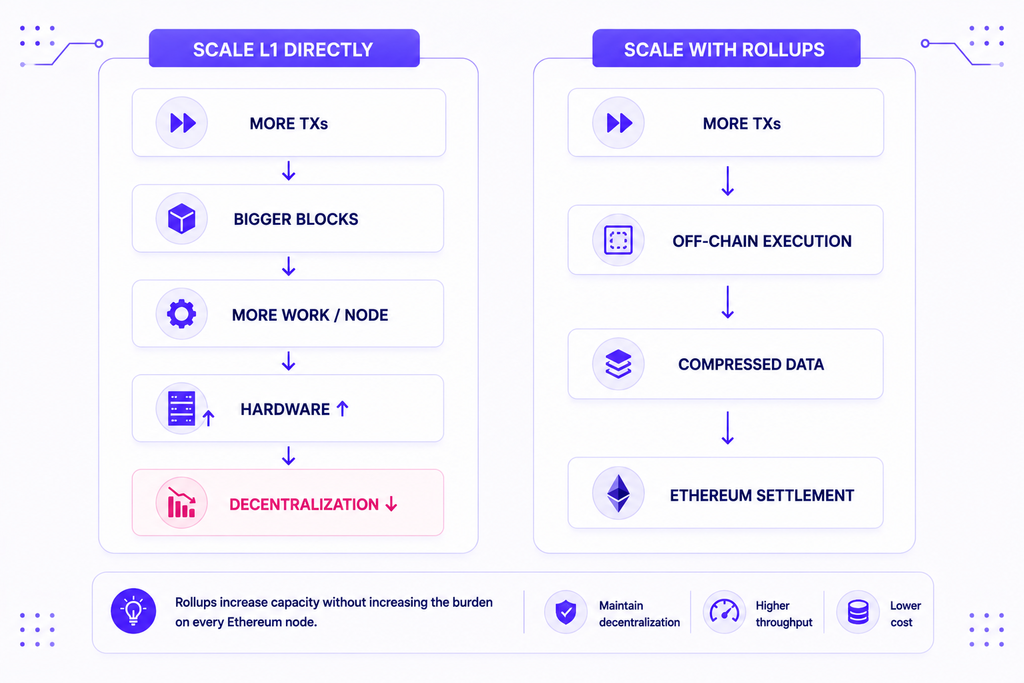
Rollups are that something else. They execute transactions off-chain and post a compressed summary back to Ethereum, and publishing that summary used to be the expensive part for every rollup, ZK or optimistic, until Ethereum started posting rollup data as blobs instead of ordinary transaction calldata. A ZK-rollup’s specific contribution is closing the trust gap instantly instead of leaving a window for someone to dispute it: an optimistic rollup like Arbitrum assumes a batch is valid and gives challengers roughly a week to prove otherwise, while a ZK-rollup proves the batch upfront, so there’s nothing left to dispute.
The zk vs optimistic rollup trade-off comes down to three practical differences:
| ZK-rollup | Optimistic rollup | |
|---|---|---|
| Trust model | Proven before accepted | Assumed valid, challengeable |
| Typical withdrawal | Minutes to hours | ~7-day challenge period |
| 2026 examples | zkSync Era, Starknet, Linea | Arbitrum, Optimism, Base |
Who Actually Builds and Trades on These Networks?
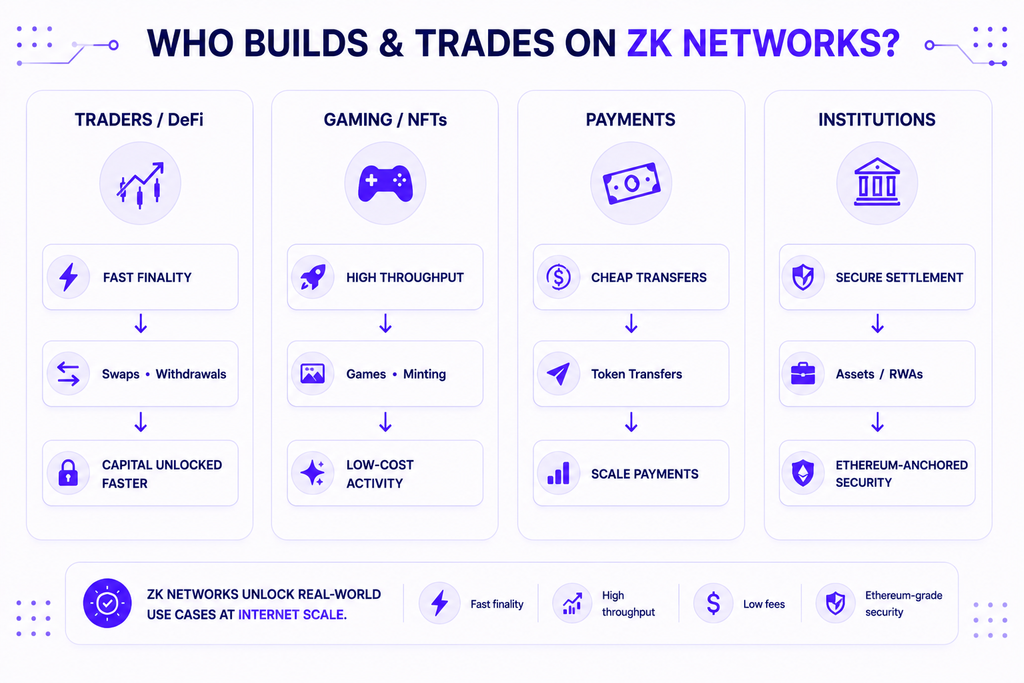
Traders and DeFi protocols are the most obvious audience, and the reason is finality speed. A swap or a withdrawal that would sit behind Arbitrum’s roughly week-long challenge period clears in minutes once a ZK-rollup’s proof verifies on Ethereum, which matters to anyone who doesn’t want capital locked up waiting.
Gaming and NFT platforms lean on the same proof system for a different reason: cheap, high-frequency transactions. Immutable operates two chains built this way — Immutable X, on StarkWare’s proving technology, and Immutable zkEVM, on Polygon’s CDK stack. The latter was explicitly confirmed unaffected when Polygon wound down its shared zkEVM network in 2026, since it runs as its own independent chain rather than on the retired shared one.
Payments were the very first use case — Loopring’s original zk-rollup handled nothing but token transfers — and they’re becoming relevant again at the institutional end. Matter Labs, the company behind zkSync, spent 2026 pitching banks and asset managers on privacy-preserving settlement built on the same proof system. “Assets are custodied on Ethereum L1, and ZK-proofs are used to safely reflect their movement across ZK Chains,” said Matter Labs co-founder and CEO Alex Gluchowski, describing how the model keeps funds anchored to Ethereum’s security while proofs handle the accounting.
From Payment-Only Experiments to Full Smart-Contract Chains
The current wave of zkEVMs isn’t the first generation, and treating it as the whole story is exactly the kind of outdated framing this space has outgrown. Loopring launched the first live zk-rollup on Ethereum mainnet in December 2019 — a trading exchange with no smart-contract support at all, since the cryptography of the time could only prove simple transfers, not general-purpose computation.
Matter Labs followed in 2020 with zkSync 1.0, later renamed zkSync Lite — fast transfers and NFT minting, but still no smart contracts. Both projects were genuine breakthroughs, and both are now retired.
Loopring shut down its exchange on June 29, 2026, after volume fell more than 99% from a $760 million peak in November 2021 to roughly $8 million; the team pointed to the missing virtual machine — no composability, limited payment use cases — as the root cause. zkSync Lite is being sunset later the same year, with Matter Labs putting it plainly: “It did its job: prove what’s possible and pave the way for the next generation.”
General-purpose zkEVMs — rollups that run ordinary Ethereum smart contracts, not just transfers — arrived in 2023. zkSync Era launched that February with Uniswap and SushiSwap already deployed; Polygon zkEVM followed in March, built on Hermez Network technology Polygon had acquired for $250 million in 2021; Starknet, Linea, and Scroll rounded out the field the same year.
That Polygon zkEVM chain no longer exists, which matters because plenty of guides still describe it as a current option. Polygon shut down its zkEVM mainnet-beta sequencer on July 1, 2026, after the chain peaked near $187 million in value locked and ran at over $1 million a year in losses; leadership cited slow support for Ethereum’s blob upgrade and, more fundamentally, a failure to differentiate the product. Anyone searching for a Polygon zk rollup in 2026 is really looking for Polygon’s current approach — AggLayer, a cross-chain settlement layer built with the same CDK toolkit, alongside the original Polygon PoS chain, which was never itself a zk-rollup.
| Network | Launched | 2026 status |
|---|---|---|
| Loopring exchange | Dec 2019 | Shut down (June 29, 2026) |
| zkSync 1.0 / Lite | 2020 | Being sunset |
| Starknet (Alpha) | Nov 2021 | Active, Stage 1 |
| zkSync Era | Feb 2023 | Active |
| Polygon zkEVM | March 2023 | Shut down (July 1, 2026) |
| Linea | 2023 | Active |
| Scroll | 2023 | Active |
Where Does the Value Actually Sit in 2026?
Despite the technical head start on finality, ZK-rollups still hold a small fraction of the money sitting on Ethereum Layer-2s. The table below is pulled from L2Beat, alongside each network’s decentralization “stage” — Stage 0 means a security council can still override the system, Stage 1 means meaningful trust-minimization is live, and Stage 2, which no ZK-rollup has reached yet, would mean no admin keys at all.
| ZK-rollup | TVL | Stage |
|---|---|---|
| Linea | $424.7M | 0 |
| Starknet | $379.6M | 1 |
| zkSync Era | $220.7M | 0 |
| Scroll | $46.9M | 0 |
| Taiko | $11.5M | 0 |
Figures from L2Beat’s scaling summary, pulled August 2026 — TVL shifts daily, so treat this as a snapshot rather than a fixed ranking.
Add those five up and the total sits close to $1.1 billion. Compare that to the optimistic side of the ledger, where Base and Arbitrum One each individually secure more than $10 billion, and the gap is obvious: ZK-rollups have the stronger finality story, but optimistic rollups still hold the deeper liquidity, largely because they shipped years earlier with near-native EVM support. Starknet is the only ZK-rollup to reach Stage 1 so far, a milestone it hit in 2025.
What Still Doesn’t Work Perfectly?
Generating a validity proof is computationally expensive — historically the single biggest cost of running a ZK-rollup, since a prover needs serious hardware to turn a batch of transactions into a proof fast enough to be useful. That cost has been falling as proving hardware and recursive proof techniques improve, but it hasn’t disappeared.
Centralization is the other honest weak spot. Every network in the table above runs at Stage 0 or Stage 1, meaning a sequencer — usually operated by the team itself — decides transaction ordering, and a security council can still step in on upgrades. That’s not unique to ZK-rollups; optimistic rollups started the same way. But it does mean “cryptographically secured” and “decentralized” aren’t the same claim, and the second one isn’t fully true of any ZK-rollup yet.
None of that changes what a developer actually needs to build on one of these networks: reliable read and write access to the chain, since zkEVMs run standard Solidity contracts and most of the same tooling used on Ethereum works with only minor changes. NOWNodes, for instance, provides RPC access to zkSync, Starknet, and Linea alongside more than 120 other supported networks, so a team isn’t running separate infrastructure for every rollup it wants to support.
Conclusion
A ZK-rollup’s whole pitch comes down to one substitution: proof instead of patience. Where an optimistic rollup asks users to wait out a challenge period on the assumption nothing went wrong, a ZK-rollup checks the math first and finalizes in minutes.
That’s a real advantage, and it’s why zkSync Era, Starknet, and Linea keep growing while the technology’s payment-only pioneers — Loopring, zkSync Lite, and now Polygon’s original zkEVM — have all been retired in 2026. The trade-off is that the current generation is younger, smaller by total value locked, and still centralized enough that only one ZK-rollup has earned L2Beat’s Stage 1 label so far.
None of this is financial or technical advice. TVL, decentralization stages, and which networks are even still running all shift fast enough in this space that it’s worth confirming current figures before making a decision that depends on them.
FAQ
Is a Validity-Proof Rollup the Same Thing as a Layer 2?
Not exactly — it’s one specific type of Layer 2, sometimes shortened to “ZK L2.” Layer 2 is the broader category that also includes optimistic rollups, validiums, and state channels; what sets this type apart is proving correctness with a validity proof rather than any other trust mechanism.
What Happened to Polygon’s zkEVM?
Polygon shut down its zkEVM mainnet-beta sequencer on July 1, 2026, after it never matched the adoption or liquidity of newer zkEVMs and ran at a persistent loss. Polygon’s current zero-knowledge work continues through AggLayer and its CDK toolkit, which power independent chains like Immutable’s, rather than the retired shared network.
What’s the Difference Between a zk-SNARK and a zk-STARK?
Both are validity proofs, but a zk-SNARK is smaller and cheaper to verify, typically at the cost of requiring a trusted setup ceremony to generate its parameters. A zk-STARK produces a larger proof and skips the trusted setup entirely, using hash-based cryptography that’s also considered resistant to future quantum computers.
Do Zero-Knowledge Networks Have Their Own Tokens?
Most do. Starknet has STRK and zkSync has ZK, both used mainly for governance and, on some networks, transaction fees — though owning the token isn’t required to use the network itself.
Can a Rollup’s Sequencer Go Down or Censor a Transaction?
Yes, on today’s networks. Every major ZK-rollup still runs Stage 0 or Stage 1 infrastructure, meaning a single sequencer operator controls transaction ordering, and most also keep a security council with override power over upgrades.
How Much Cheaper Are These Transactions Than Ethereum’s Own?
Costs vary by network and by how busy Ethereum’s base layer is, but fees on established zkEVMs typically run a small fraction of a cent to a few cents per transaction, versus a dollar or more on Ethereum during congestion. Check a network’s own fee tracker for current numbers, since this moves with both Ethereum gas prices and each rollup’s proving costs.