
The blockchain trilemma is the observation that a blockchain can fully optimize for only two of three properties at once: decentralization, security, and scalability. Push a network to process more transactions and it usually leans on fewer, more powerful validators to do it — which chips away at decentralization, security, or both.
That trilemma is why Bitcoin still settles around 7 transactions per second while your bank card clears a payment in seconds, and why some “faster” blockchains run on a validator set you could count in the dozens. It’s not a bug anyone forgot to fix. It’s a structural constraint that shapes almost every real design decision a blockchain team makes.
Below is the blockchain trilemma explained from first principles: what the three properties actually mean, why they pull against each other, how real networks compare, and what current fixes actually change. It’s also sometimes called the scaling trilemma, the blockchain scalability trilemma, the crypto trilemma, or just the blockchain triangle — same three-way trade-off, different name.
How Vitalik Buterin Defined It
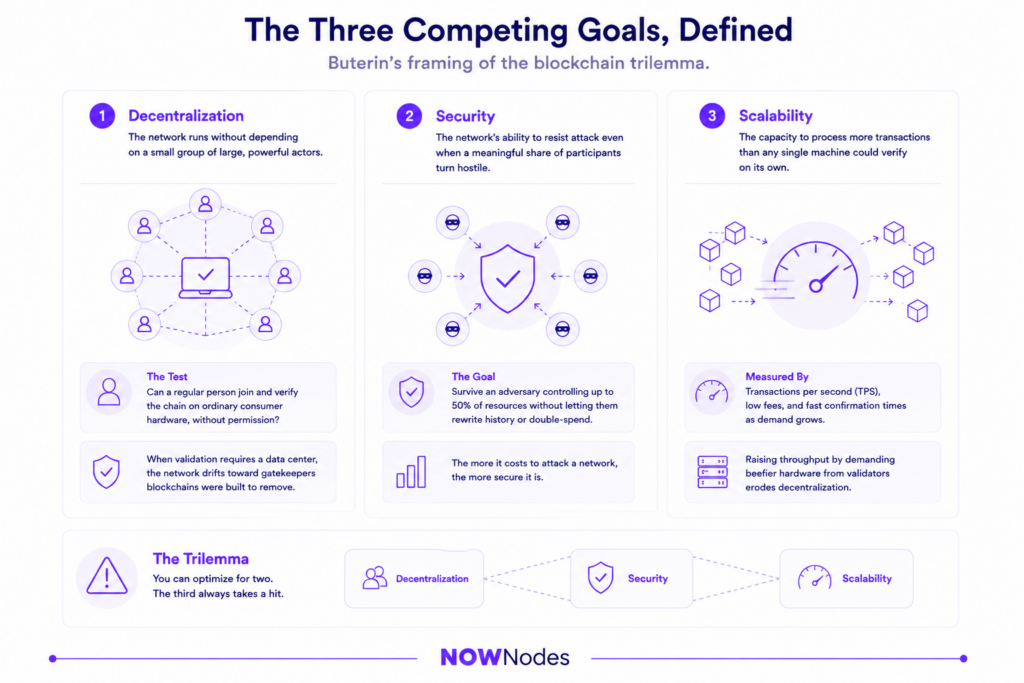
The term is most closely tied to Ethereum co-founder Vitalik Buterin, who laid it out precisely in an April 2021 essay explaining why Ethereum was moving toward rollups and a new scaling design. “The scalability trilemma says that there are three properties that a blockchain tries to have, and that, if you stick to ‘simple’ techniques, you can only get two of those three,” he wrote, naming the three as scalability, decentralization, and security.
That “simple techniques” qualifier matters more than it looks. Buterin wasn’t describing a mathematical law no blockchain could ever escape — he was describing what happens with straightforward, single-layer designs. More complex engineering, layering extra systems on top of a base chain, is exactly what the second half of this piece covers.
The underlying tension isn’t unique to crypto, either. Distributed-systems researchers have wrestled with a similar three-way trade-off since Eric Brewer’s CAP theorem in 2000, which says a distributed database can’t guarantee consistency, availability, and partition tolerance all at once. Blockchains inherited a version of that same problem and gave it a catchier name.
The Three Properties Every Blockchain Is Balancing
Each property sounds simple alone. The friction only shows up once a network tries to maximize all three together.
| Property | What it means | What threatens it |
|---|---|---|
| Decentralization | No single actor or small group controls the network; ordinary people can run a node on consumer hardware | Requiring specialized, expensive hardware just to keep up with the chain |
| Security | The network resists attacks — double-spends, censorship, 51% attacks — even from adversaries with real resources | A validator or miner set small or cheap enough for one party to control a majority |
| Scalability | The chain processes meaningfully more transactions than a single consumer machine could verify alone, without fees spiking | Every added participant having to redundantly re-verify the same data, which caps total throughput |
Here’s why they conflict. Decentralization needs nodes cheap enough that ordinary people can run one, which means each node is deliberately not that powerful. Modest hardware can only verify so much data per second, and that ceiling caps how fast the whole network can move.
Raise the ceiling by demanding beefier hardware, and fewer people can afford to participate — decentralization drops. Trust a smaller group to do more of the work instead, and the pool an attacker would need to compromise gets narrower — security drops, or at least the threat model changes. Every scaling approach eventually runs into one side of the trilemma.
How Networks Compare in the Real World
Numbers make the trade-off concrete faster than definitions do. Here’s where several major networks actually land at the base layer, using real observed throughput rather than marketing figures.
| Network | Real-world throughput | Validator / node set | What it prioritizes |
|---|---|---|---|
| Bitcoin | ~7 TPS | Proof of Work; tens of thousands of full nodes verify every block | Decentralization and security over speed |
| Ethereum (L1) | ~26 TPS | Proof of Stake; 900,000+ validators | Decentralization and security; scaling pushed to Layer-2 |
| BNB Smart Chain | ~285 TPS | Proof of Staked Authority; ~45 validators, 21 producing at a time | Speed and low fees over validator count |
| Solana | ~1,500–1,900 TPS sustained (65,000 theoretical max) | Proof of History + PoS; 906 active validators | Base-layer throughput, with a smaller validator set than Ethereum |
Figures from CoinLaw’s 2026 network statistics, CoinLaw’s Solana data, SolCard’s TPS analysis, and validatorqueue.com, pulled August 2026.
One popular comparison deserves a correction: Visa. Crypto explainers love to cite “Visa handles 24,000 TPS” as the bar blockchains need to clear. In practice, Visa’s network runs at roughly 1,700 transactions per second on average — the 24,000 figure traces back to old marketing material describing theoretical lab capacity, not what the network actually processes day to day, as payments-focused reporting has pointed out.
Solana’s own gap tells a similar story. Its Proof of History design theoretically supports up to 65,000 TPS, but sustained real-world throughput runs 1,500 to 1,900 TPS, and its active validator count has actually fallen — from about 2,560 in early 2023 to 906 in 2026, according to CoinLaw. Faster blocks, fewer people checking them: the trilemma cutting the same way twice.
Who Actually Runs Into This Trade-Off?
Developers, traders, and infrastructure teams all run into the trilemma, even when they don’t call it that. Each group feels it differently.
Developers feel it first, when choosing where to build. A team shipping a high-frequency trading app or game leans toward Solana, BNB Smart Chain, or a Layer-2 rollup, where fees are fractions of a cent and blocks land fast. A team building custody, settlement, or anything holding meaningful value tends to lean toward Ethereum’s base layer, where a validator set of 900,000-plus, staking real collateral, makes a 51% attack expensive to the point of impractical.
Traders and everyday users feel the fee side directly. A dollar-plus fee for a simple swap on Ethereum’s base layer versus a fraction of a cent on a rollup or BNB Smart Chain is the trilemma showing up on a receipt, even if nobody names it that way.
Institutions and infrastructure teams feel it as an operations problem. Because no single chain wins on all three properties, most multi-chain products end up needing reliable access to several networks with very different trade-off profiles instead of standardizing on one. Connecting to a validator-heavy chain like Ethereum and a smaller, faster set like Solana or BSC means reaching very different kinds of infrastructure — which is why providers such as NOWNodes expose RPC access to 120-plus networks through one API, so a team doesn’t have to run a separate node stack for every trade-off it wants to support.
How Projects Try to Escape the Trade-Off
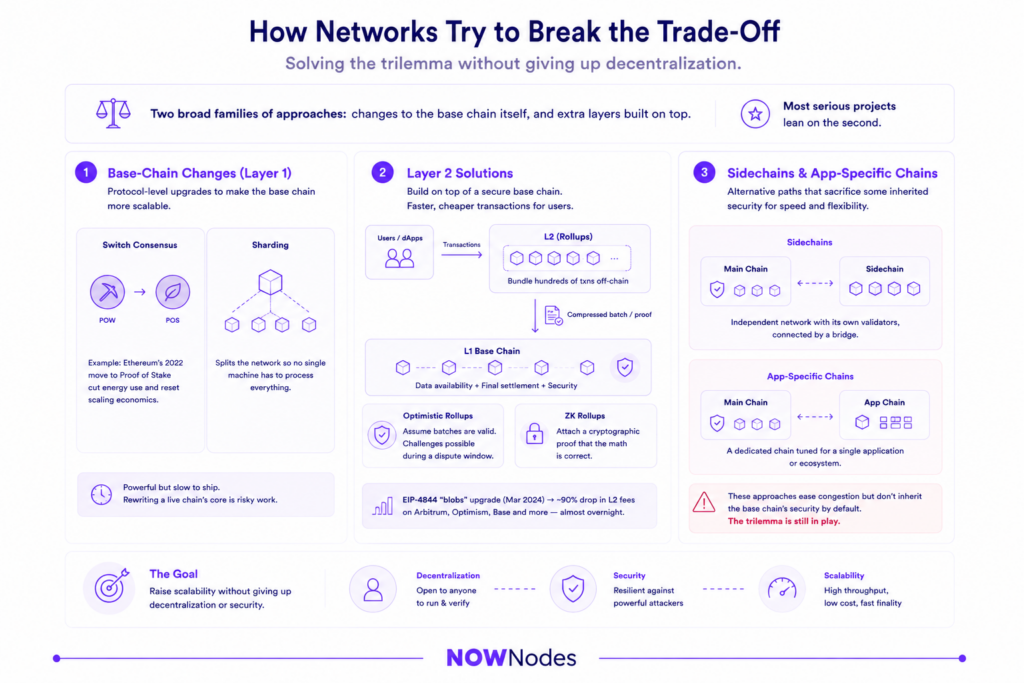
No fix eliminates the trilemma outright. Each one just moves it somewhere else.
Layer-2 Rollups
Rollups bundle thousands of transactions off the main chain, then post a compressed summary back to it. Optimistic rollups such as Arbitrum and Optimism assume transactions are valid and allow a challenge window to catch fraud; zero-knowledge rollups such as zkSync and Starknet attach a cryptographic proof instead, so the base chain can verify correctness without waiting. Either way, users get L1-grade settlement guarantees at a fraction of L1 fees — Base and Arbitrum One each now secure more than $10 billion in value on top of Ethereum, according to L2Beat.
Splitting Up Data Instead of Execution
Ethereum’s other lever is danksharding: instead of every node downloading every byte of data rollups post, nodes verify small random samples and use math to confirm the rest is genuinely available. That mechanism, called data availability sampling, went live with the Fusaka upgrade in December 2025, and it’s a big part of why rollup fees have stayed low as usage grows.
Shrinking the Validator Set
The blunter fix is simply running fewer validators. BNB Smart Chain produces blocks through roughly 45 validators instead of Ethereum’s 900,000-plus, which is exactly why its blocks land in well under a second at a fraction of the cost — and exactly why it offers a smaller, more concentrated set for anyone looking to pressure it.
A newer school of thought, often called modular blockchain design, splits the job differently again: one chain handles execution, another handles consensus, and a third — Celestia is the best-known example — handles nothing but data availability. Instead of one chain trying to be good at everything, each layer specializes, and the trade-off gets spread across layers instead of absorbed by a single one.
Is the Trade-Off Actually Over?
Ethereum’s own co-founder says, for his network at least, mostly yes. On January 3, 2026, Vitalik Buterin wrote on X: “The trilemma has been solved – not on paper, but with live running code, of which one half (data availability sampling) is on mainnet today, and the other half (ZK-EVMs) is production-quality on performance today – safety is what remains,” as reported by Decrypt.
Unpacked, he’s pointing at two specific pieces. Data availability sampling — live since Fusaka — lets lightweight nodes confirm that huge amounts of rollup data are genuinely published without downloading all of it, which is what keeps the validator set large without capping throughput. ZK-EVMs, which let a node verify a cryptographic proof instead of re-executing every transaction, are fast enough for production use, but Buterin’s own wording flags that the safety work isn’t finished.
It’s worth treating that claim as one side’s assessment rather than a settled fact. It’s a genuine engineering achievement, and it’s also the person who designed the system judging his own progress. Solana, BNB Smart Chain, and most other major networks haven’t made — or needed — the same claim, because they never tried to solve the trade-off Ethereum’s way; they made a different bet up front and are living with its consequences. One architecture demonstrating a workaround doesn’t retire the trilemma for blockchain design in general.
Conclusion
The blockchain trilemma isn’t a puzzle waiting for a clever fix — it’s a description of what any blockchain gives up when it pushes on decentralization, security, or scale. Bitcoin gives up speed. BNB Smart Chain gives up validator count. Ethereum is trying to give up neither, by pushing the scaling problem onto rollups and a data layer instead of the base chain itself.
None of that makes one design objectively correct. It makes the trade-off worth knowing before picking a chain to build on, trade on, or hold funds on — because whichever one gets chosen, it already made this decision on the builder’s behalf.
FAQ
Is this trade-off a proven law, or just an observation?
The blockchain trilemma is an observation, not a theorem. Vitalik Buterin’s own definition specifies “simple” techniques only, which is why rollups, sharding, and other layered designs can — and do — push past what a single-layer chain could achieve alone.
Which blockchain balances these three properties best?
There’s no settled winner. Ethereum leans on Layer-2s to add scale without touching its base-layer validator set, Solana pushes raw base-layer throughput with fewer validators, and BNB Smart Chain shrinks its validator set outright for speed and cost. Each is a different bet, not a different answer to the same test.
Does Bitcoin face the same three-way trade-off?
Yes — call it the bitcoin trilemma in action. Bitcoin prioritizes decentralization and security, which is why its base layer still runs around 7 transactions per second; scaling happens through second-layer systems like the Lightning Network rather than changes to Bitcoin itself.
Can Layer-2 rollups fully escape this constraint on their own?
Not entirely — they shift it rather than remove it. A rollup inherits Ethereum’s security and data availability for settlement but still makes its own choices about sequencer centralization and proof type, so the trade-off just moves down a layer instead of disappearing.
Is this idea related to the CAP theorem?
Loosely, yes. Both describe a distributed system that can’t maximize every desirable property simultaneously — CAP theorem for databases balancing consistency, availability, and partition tolerance, the blockchain trilemma for decentralization, security, and scale. They’re not the same theorem, but they’re the same family of constraint.
Why can’t blockchains just scale by using more powerful hardware?
Because that raises the cost of participating. If verifying the chain requires data-center-grade hardware, fewer independent people can afford to run a node, and the network consolidates around whoever can — trading decentralization away for the extra throughput.