
Both Polkadot and Cosmos exist to solve the same problem: how do you build a custom blockchain that can talk to other chains without inheriting the congestion of a single shared Layer-1? They answer it in almost opposite ways. Cosmos hands each chain full sovereignty and connects them with a shared messaging standard. Polkadot pools security under one relay chain and lets projects rent compute on it.
That core split hasn’t changed since these ecosystems launched. What has changed — and what makes a 2025-era comparison misleading in 2026 — is nearly everything around it. Polkadot spent 2025 finishing its 2.0 overhaul and is now testing a ground-up replacement for its relay chain. Cosmos extended its messaging protocol to Ethereum and reorganized its entire development effort under a single company. If you last evaluated these two a year ago, the trade-offs you remember are out of date.
This guide walks from the foundational architecture up to the practical decision, updated for where both stacks actually are as of mid-2026. It’s written for technical founders and dev teams weighing a real build, not for traders — so the focus stays on infrastructure, interoperability, developer experience, and cost.
The Core Difference: Sovereignty vs Shared Security
Start with the one distinction that everything else flows from. It’s the difference between owning your house outright and renting a well-guarded apartment.
How Cosmos Works: A Network of Sovereign Chains
Cosmos isn’t a single blockchain. It’s a toolkit — the Cosmos SDK and the CometBFT consensus engine — for building independent chains, often called appchains or zones, that each run their own validator set and set their own rules. A zone controls its consensus, governance, tokenomics, and upgrade schedule with no dependence on any other chain.
Those sovereign chains talk to each other over the Inter-Blockchain Communication protocol (IBC), a shared standard that lets separate blockchains pass tokens and data between themselves with no middleman in the loop. The postal system is the closest everyday parallel: every chain addresses and packages its messages the same way, so any two of them can trade mail. And it runs at real scale — more than 115 chains support IBC in 2026, carrying somewhere around $3 billion in transfers each month.
Sovereignty like this cuts both ways. A new Cosmos chain answers to no one, but it also starts with nothing: it has to stand up its own validator set and staking economy before it can secure a single block, then keep that machinery running for as long as the chain exists.
How Polkadot Works: Parachains Under a Relay Chain
Polkadot flips the arrangement. It sits a layer beneath the chains it serves — a Layer-0 protocol whose job is to host other blockchains, called parachains, instead of competing with them for users. Everything routes through a central Relay Chain, and that’s where the two designs split. A parachain doesn’t run its own validators. It borrows Polkadot’s, so security arrives bundled the moment it plugs in.
For a small team, that’s an enormous head start: you skip the hardest and riskiest part of launching a chain and pour your effort into the application instead. What you give up is independence. A parachain lives inside the Relay Chain’s rules and votes alongside the rest of the ecosystem rather than governing its own affairs.
Gavin Wood built Polkadot after co-founding Ethereum, writing its Yellow Paper, and coining the term “Web3.” His framing of the network has stayed consistent: a shared layer for security and communication, where developers launch their own chains and wire them into one system instead of fighting over a single platform.
The Trade-off in One Line
Strip everything else away and the choice is this: Cosmos optimizes for sovereignty, Polkadot for shared security. Every difference that follows traces back to that one fork in the road.
| Cosmos | Polkadot | |
|---|---|---|
| Core architecture | Sovereign appchains (zones) + Cosmos Hub | Parachains connected to a shared Relay Chain |
| Security model | Independent validator set per chain | Shared security from Relay Chain validators |
| Interoperability | IBC (production, 115+ chains, now reaching Ethereum) | XCM between parachains; external bridges beyond |
| Consensus | CometBFT (Tendermint) — instant finality | BABE + GRANDPA (hybrid, Relay Chain coordinated) |
| Build framework | Cosmos SDK (Go) | Substrate / Polkadot SDK (Rust) |
| Access cost model | Launch and run your own chain | Agile Coretime — pay for blockspace as you use it |
What Changed in 2026: The Updates That Matter
If your mental model of these two is from 2024 or early 2025, four developments have reshaped the comparison. This is the section a year-old article can’t give you.
Polkadot Finished 2.0 — and Killed the Slot Auction
For years, the biggest knock against Polkadot was its onboarding. Launching a parachain meant winning a candle auction and locking large amounts of DOT for lease periods of up to two years — a serious capital barrier for smaller teams.
That’s gone. Agile Coretime, which lets developers buy network compute time by the month or even block by block, went live in September 2024 and was finalized with the Polkadot SDK 2509 release in October 2025, completing the three-pillar Polkadot 2.0 upgrade alongside Asynchronous Backing and Elastic Scaling. The practical effect: launching on Polkadot now means paying for what you use, when you use it — much closer to a cloud-compute model than a real-estate lease. Polkadot’s own ecosystem writeups report over 150 new dApps added in Q1 2026 alone, which the teams attribute largely to this shift.
Polkadot’s Next Leap: JAM
The bigger story is what comes next. JAM (the Join-Accumulate Machine) is a proposed replacement for the Relay Chain itself — announced by Gavin Wood in April 2024 and approved by DOT holders in a near-unanimous May 2024 governance vote backed by over 31 million DOT.
JAM’s ambition is to turn Polkadot from a parachain host into a general-purpose decentralized computer. Instead of the Relay Chain being hard-wired to run parachains, JAM introduces permissionless services — anyone can deploy computation without an auction or governance approval — running across 350-plus parallel cores on a new RISC-V-based virtual machine. Wood has described it as a “less opinionated version” of Polkadot: it stops pushing developers toward any single approach.
Two caveats keep this honest. First, JAM is not live on mainnet. A public testnet launched in January 2026, with 43 independent teams building implementations across 15 programming languages and competing for a 10 million DOT prize pool from the Web3 Foundation. The mainnet governance proposal is expected in the Q3–Q4 2026 window. Second, JAM’s headline numbers — a theoretical 1 million TPS and 850 MB/s of bandwidth — are design targets from the Gray Paper, not measured production throughput. Treat them as direction, not delivery.
Cosmos Extended IBC to Ethereum with Eureka
Cosmos’s marquee 2025–2026 development is IBC Eureka, an upgrade built on IBC v2 that connects the Cosmos interchain directly to Ethereum using zero-knowledge light-client proofs rather than a traditional bridge. The first live ATOM transfer between the Cosmos Hub and Ethereum mainnet landed on March 28, 2025.
Why this matters: IBC’s long-standing limitation was that it mostly connected Cosmos chains to other Cosmos chains. Eureka breaks that boundary. Transfer fees on Ethereum–IBC routes have dropped to around $1 or less, and Cosmos Labs’ published 2026 roadmap targets Solana and general EVM/L2 support next, aiming to add dozens of networks over the year. Cosmos is trying to make IBC a universal standard rather than an internal one.
Both Ecosystems Reset Their Tokenomics
Finally, the economics on both sides changed in ways that affect long-term planning.
Polkadot implemented a hard supply cap of 2.1 billion DOT via Referendum 1710, with a step-down inflation schedule beginning in March 2026 that roughly halves emissions every two years — a Bitcoin-like scarcity model replacing open-ended issuance.
Cosmos, meanwhile, kicked off a formal ATOM tokenomics redesign through Cosmos Labs, aiming to move ATOM away from its historic 7–20% inflation toward a sustainable, fee-based model where the token accrues value from real network usage. As of mid-2026 this is still a governance-and-research process, not finished code — an important distinction if you’re modeling token costs.
Interoperability Head to Head: IBC vs XCM
Cross-chain messaging is where these two are most directly comparable, and it’s Cosmos’s strongest card.
Cosmos’s IBC is arguably the most battle-tested interoperability layer in the industry. It’s been in production since 2021, connects 115-plus chains, and — with Eureka — now reaches outside its own ecosystem to Ethereum. If your project’s value depends on moving assets and data across many chains today, IBC is the more proven foundation.
Polkadot’s answer is XCM (Cross-Consensus Messaging), the language parachains use to communicate under the shared Relay Chain. Within the Polkadot ecosystem, XCM is tightly integrated and benefits from shared security — messages between parachains don’t cross a trust boundary the way a bridge does. Its historical weakness has been reach beyond Polkadot itself, which is part of what JAM’s mandatory full XCMP support is meant to strengthen.
The honest summary: for raw cross-chain volume and external reach right now, Cosmos leads. For tightly integrated, trust-minimized messaging within a single security umbrella, Polkadot’s model is architecturally cleaner. Which matters more depends entirely on whether your users live inside one ecosystem or span many.
If you want a deeper primer on how these networks move data under the hood, our guide to blockchain interoperability walks through the mechanics.
Developer Experience: Cosmos SDK vs Substrate
The framework choice shapes your timeline and your hiring more than almost anything else.
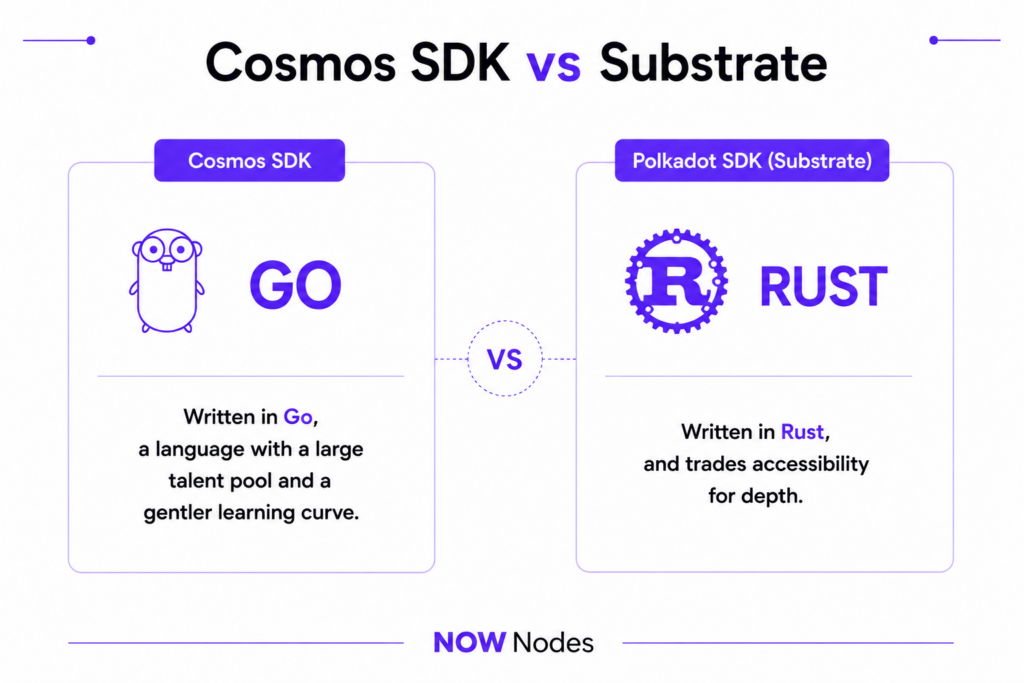
Cosmos SDK is written in Go, a language with a large talent pool and a gentler learning curve. It’s modular by design: pre-built modules for staking, governance, accounts, and IBC let a team stand up a functional appchain quickly. If speed to a working testnet matters, this is the friendlier path — and it’s why chains like dYdX, Celestia, and Cronos were built on it.
Substrate (now the Polkadot SDK) is written in Rust and trades accessibility for depth. It gives developers fine-grained control over the runtime, consensus primitives, and low-level logic — genuinely powerful for teams that need to customize the protocol itself, but a steeper climb that demands Rust expertise. JAM pushes this further, with implementations spanning 15 languages and a new RISC-V virtual machine underneath.
The rule of thumb hasn’t changed: choose Cosmos SDK for faster time-to-market, Substrate for deep protocol customization. What has changed is that Polkadot’s coretime model now lowers the operational barrier that used to compound Substrate’s technical one.
Consensus and Finality: CometBFT vs BABE/GRANDPA
Under the hood, the two consensus designs reflect their philosophies.
Cosmos chains run CometBFT (the maintained successor to Tendermint), which delivers instant finality — once a block is committed, it’s final, with no probabilistic waiting. It’s simple to configure and has years of production uptime behind it. For applications that need deterministic settlement — payments, exchanges, anything where “probably final” isn’t good enough — that’s a meaningful advantage.
Polkadot splits the job in two: BABE handles block production while GRANDPA handles finality, a hybrid that optimizes for parallelism across many parachains at the cost of more internal complexity. It’s a reasonable trade for a system coordinating dozens of chains at once, but it’s harder to reason about than a single BFT engine.
If predictable, fast finality and simple operation top your list, Cosmos is the easier system to run. If you’re building inside a large multi-chain ecosystem and want layered coordination, Polkadot’s split model earns its complexity.
Governance: Independent vs Ecosystem-Wide
Governance is the last major axis, and it mirrors the sovereignty split exactly.
Each Cosmos chain runs its own on-chain governance. Token holders vote on that chain’s upgrades, parameters, and treasury without waiting on any other network. On the Cosmos Hub, the process requires a 40% quorum of staked tokens and a simple majority to pass. That independence is ideal if you need fast iteration, chain-specific rules, or regional compliance baked into your own governance.
Polkadot centralizes more decision-making at the Relay Chain level through its OpenGov system. That’s efficient for coordinating ecosystem-wide changes — the JAM vote is a good example of the whole network moving together — but it can slow decisions that a fully sovereign chain would make on its own. Recent Polkadot referenda in July 2026 also cut the staking unbonding period from 28 days to roughly 48 hours and eliminated slashing risk for nominators, showing that OpenGov can move quickly when the community aligns.
For chain-specific autonomy, Cosmos wins. For coordinated evolution of a shared platform, Polkadot’s model is the point.
Final Verdict: Which Should You Build On in 2026?
There’s no universal winner — the right choice depends on what you’re optimizing for. Here’s the decision compressed.
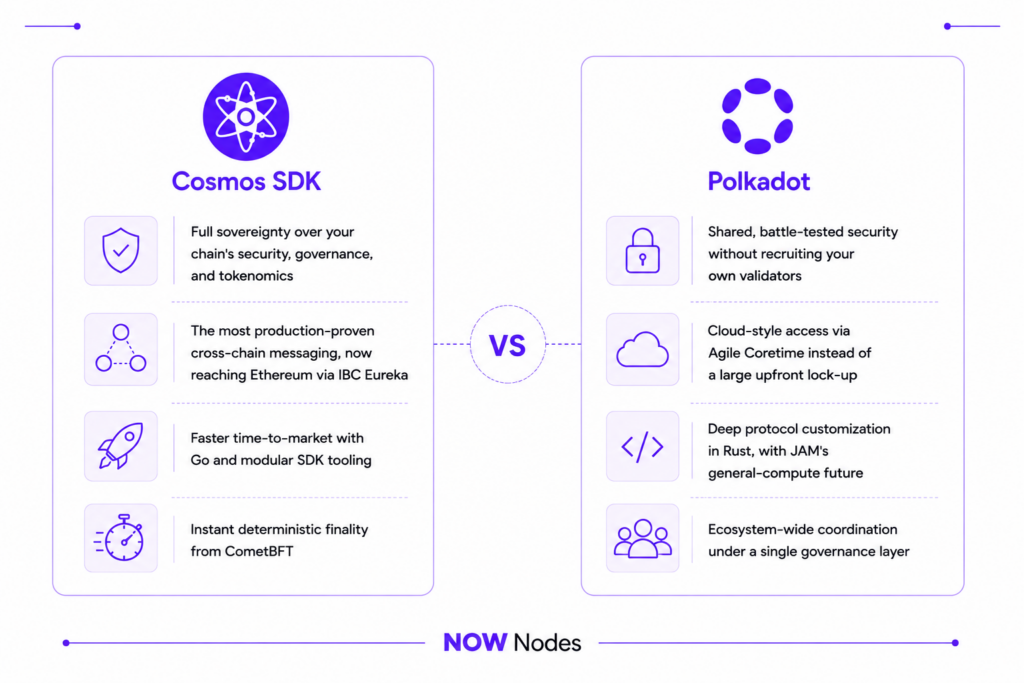
Choose Cosmos if you want:
- Full sovereignty over your chain’s security, governance, and tokenomics
- The most production-proven cross-chain messaging, now reaching Ethereum via IBC Eureka
- Faster time-to-market with Go and modular SDK tooling
- Instant deterministic finality from CometBFT
Choose Polkadot if you want:
- Shared, battle-tested security without recruiting your own validators
- Cloud-style access via Agile Coretime instead of a large upfront lock-up
- Deep protocol customization in Rust, with JAM’s general-compute future on the roadmap
- Ecosystem-wide coordination under a single governance layer
A useful way to decide: if your project’s identity depends on controlling its own economics and connecting broadly across ecosystems, lean Cosmos. If it depends on inheriting strong security cheaply and living inside a tightly integrated network, lean Polkadot.
Whichever you choose, reliable infrastructure is what turns the decision into a working deployment. NOWNodes provides production-grade node access for both ecosystems — see our Cosmos node and Polkadot node pages to connect without running the hardware yourself.
FAQ
What is the main difference between Polkadot and Cosmos?
Cosmos gives each blockchain full sovereignty — its own validators, governance, and tokenomics — and links them with the IBC messaging protocol. Polkadot pools security under a shared Relay Chain, so parachains inherit validation automatically but operate with less autonomy. In short: Cosmos prioritizes independence, Polkadot prioritizes shared security.
Is Cosmos or Polkadot better for cross-chain messaging in 2026?
Cosmos’s IBC is the more proven layer today — over 115 connected chains, roughly $3 billion in monthly transfer volume, and, since the IBC Eureka upgrade, a direct connection to Ethereum. Polkadot’s XCM is tightly integrated within its own ecosystem thanks to shared security, but has historically had less reach beyond it.
What is JAM and is it live yet?
JAM (Join-Accumulate Machine) is Polkadot’s proposed replacement for the Relay Chain, turning the network into a general-purpose decentralized computer. As of mid-2026 it is not on mainnet — a public testnet launched in January 2026 with 43 teams building implementations, and a mainnet governance proposal is expected in the Q3–Q4 2026 window.
Which is easier to build on, Cosmos SDK or Substrate?
Cosmos SDK (Go) generally has a gentler learning curve and faster time-to-market, thanks to modular pre-built components. Substrate/Polkadot SDK (Rust) offers deeper protocol-level customization but requires more expertise. Choose based on whether you value speed or fine-grained control.
Did Polkadot get rid of parachain slot auctions?
Yes. The old model of winning a two-year candle auction and locking DOT was replaced by Agile Coretime, which lets developers buy blockspace by the month or block. It went live in September 2024 and was finalized with the SDK 2509 release in October 2025.
How did the tokenomics change for each in 2026?
Polkadot introduced a hard 2.1 billion DOT supply cap with step-down inflation starting March 2026. Cosmos launched a formal ATOM tokenomics redesign aiming to shift from 7–20% inflation toward a fee-based model — though as of mid-2026 that remains a governance process, not finalized code.