
MEV, or maximal extractable value, is the extra profit someone can earn by controlling the order of transactions inside a block — deciding which trades go first, which go last, and which get dropped entirely. On a public blockchain, your pending transaction sits out in the open for a few seconds before it’s confirmed, and that short window is enough for specialized bots to reorder the queue in their favor. Most people never notice it happening, which is why MEV gets called crypto’s “invisible tax.” Here’s what it actually is, who profits from it, and how it quietly reaches into ordinary trades like yours.
What Is Maximal Extractable Value?
Let’s start simple. Every transaction you send — a swap, a transfer, a loan repayment — doesn’t confirm the instant you hit send. It first lands in a public waiting room called the mempool, where it sits alongside thousands of others until a validator picks it up and packs it into the next block.
Mempool is the pool of pending, unconfirmed transactions waiting to be included in a block. Anyone running a node can watch it in real time. (Source: ethereum.org)
The important part is that validators don’t have to process transactions in the order they arrived. They can arrange them however they want, and usually they arrange them to maximize revenue. Maximal extractable value (MEV) is the profit captured by reordering, inserting, or censoring transactions during that block-building step. This is critical to grasp up front: it isn’t a hack or a bug in the code, but a structural side effect of letting someone choose the transaction order.
Maximal extractable value (MEV) is the maximum profit a block producer, or a bot working with one, can extract by adding, removing, or reordering transactions within a block — beyond the standard block reward and gas fees.
From “Miner” to “Maximal”: a Short History
The term was born in 2019. In a now-famous paper titled Flash Boys 2.0, submitted on April 10, 2019, Cornell researcher Philip Daian and seven co-authors coined the phrase “miner extractable value.” They drew the comparison to Wall Street directly: “Like high-frequency traders on Wall Street, these bots exploit inefficiencies in DEXes, paying high transaction fees and optimizing network latency to frontrun… ordinary users’ DEX trades” (Daian et al., 2019).
Then the ground shifted. After Ethereum moved to proof-of-stake at The Merge on September 15, 2022, miners were replaced by validators. The “M” was quietly redefined from miner to maximal, because the value could now be extracted by validators, builders, and searchers alike. Same idea, broader cast of characters.
How Does it Work?
MEV exists because of a time gap. Between the moment your transaction hits the mempool and the moment it’s sealed into a block, it’s visible to anyone watching — and that visibility is the entire opportunity. Bots scan the mempool for profitable patterns and race to position their own transactions around yours.
Winning that race isn’t about being clever; it’s about being fast and paying for priority. Searchers bid up gas fees or send private bundles to guarantee their transactions land in exactly the right slot. The outcome is a small, hidden economy humming underneath nearly every block on the chain.
The MEV Supply Chain: Searchers, Builders, Validators
Modern MEV runs through three roles, each handing the opportunity to the next. Think of it as an assembly line for block space:
| Role | What They Do |
|---|---|
| Searchers | Run bots that scan the mempool for profit opportunities and bundle transactions to capture them. |
| Builders | Assemble those bundles into a full, optimized block that squeezes out the most value. |
| Validators | Propose the finished block to the network and collect a share of the value as reward. |
Here’s why this structure matters. It separates the party that finds the opportunity from the party that proposes the block, which is meant to spread the power around. That separation — called proposer-builder separation — is now the backbone of how value flows on Ethereum, and we’ll return to it at the end.
Common Types of MEV
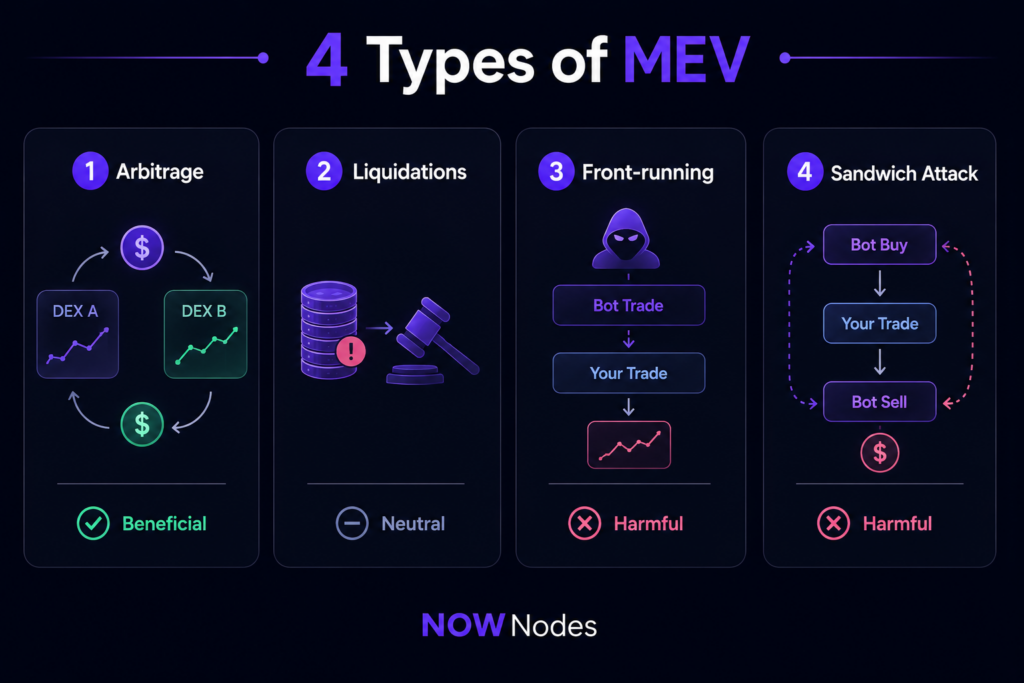
Not all of it is created equal. Some MEV keeps markets healthy; some of it comes straight out of a regular trader’s pocket. Here are the four types you’ll run into most often — this is MEV explained through the strategies people actually run.
| MEV Type | How It Works | Good or Harmful? |
|---|---|---|
| Arbitrage | Buys an asset cheaply on one DEX and sells it higher on another in the same block. | Mostly beneficial — keeps prices aligned. |
| Liquidations | Repays an under-collateralized loan to claim the liquidation bonus. | Neutral — protects lending protocols. |
| Front-running | Spots your pending trade and jumps ahead of it to profit from the price move. | Harmful — you get a worse price. |
| Sandwich attack | Places one order right before your trade and one right after, pocketing the spread. | Harmful — a direct tax on your slippage. |
Arbitrage is the workhorse of MEV and generally the “good” kind. When the same token trades at two different prices across exchanges, a bot buys low and sells high in a single transaction, nudging both markets back into line. You benefit indirectly, because prices across DeFi stay accurate and efficient.
Sandwich attacks are the type that stings. A bot sees your large swap sitting in the mempool, buys the same token just before you — pushing the price up — then lets your trade execute at that worse price and sells immediately after for a profit. Picture a $10,000 swap with loose slippage: the bot might inflate your entry price by a percent or two, quietly skimming a few hundred dollars that lands in its wallet instead of staying in yours. This is precisely the behavior that “MEV protection” tools are built to stop.
Who Uses MEV?
The players doing the extracting are mostly professional outfits: quant funds, trading firms, and independent developers running finely tuned bots. Analytics platforms like Arkham even tag known MEV bots on-chain, and the largest operators pull in millions of dollars a year across arbitrage and liquidations. This is a competitive, capital-intensive game — not a weekend hobby.
So who pays for all of it? Let’s be honest about the split. Arbitrage and liquidations are largely neutral-to-helpful, keeping DeFi markets efficient and lending protocols solvent. But front-running and sandwich attacks pull value directly from everyday users, often people who set loose slippage limits without realizing the risk. That’s the uncomfortable core of it: the same mechanism that keeps markets tidy also quietly skims from the least experienced traders.
How MEV Affects You
If you only trade occasionally on a DEX, it usually reaches you through slippage — the gap between the price you expected and the price you actually got. On a small trade in a deep liquidity pool, it’s negligible. On a large trade, or one routed through a thin pool, a sandwich bot can take a meaningful bite. The good news is that you have real defenses available.
MEV protection mostly comes down to keeping your transaction out of the public mempool, where bots can see it coming. The most popular route is a private transaction relay that sends your trade straight to builders instead of broadcasting it for everyone to front-run. Tools like MEV Blocker (built by CoW DAO) and Flashbots Protect do exactly that — and some even rebate part of the recaptured value back to you.
The scale here is not trivial. As of 2025, MEV Blocker reported protecting more than $60 billion in DEX trading volume across over 4.5 million wallets, returning 6,177 ETH in rebates to users. Flashbots Protect, for its part, had shielded roughly $43 billion in volume by late 2024. Those are large numbers for a problem most users never knew they had.
Practical Steps to Protect Yourself
You don’t need to be a developer to cut your exposure. A few habits do most of the work:
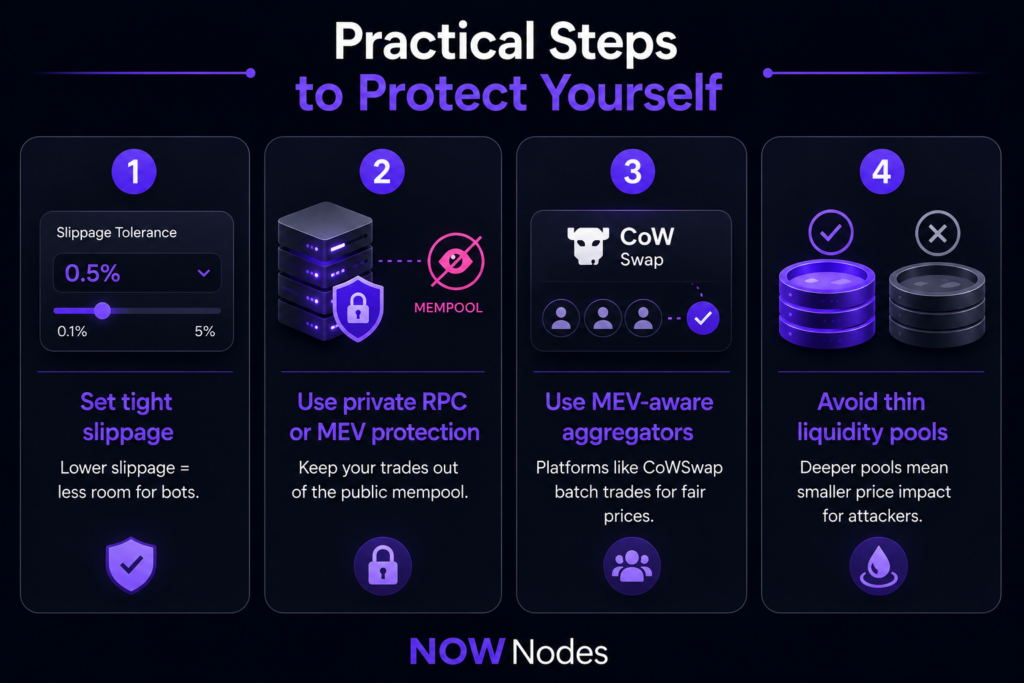
- Set a tight slippage tolerance. The lower your slippage limit, the less room a sandwich bot has to profit. Don’t leave it on “auto” for big trades.
- Use a private RPC or MEV-protected endpoint. Routing trades through MEV Blocker or Flashbots Protect hides them from the public mempool entirely.
- Trade through MEV-aware aggregators. Platforms like CoWSwap batch trades and settle them at a uniform price, removing the ordering advantage bots rely on.
- Avoid thin liquidity pools. The deeper the pool, the smaller the price impact an attacker can manufacture around your trade.
For builders and active traders operating at scale, this is where reliable infrastructure earns its keep. Submitting protected transactions, watching the mempool, or running your own strategy all depend on fast, stable access to the chain. A provider like NOWNodes supplies that connectivity across 120+ networks, so you can plug into Ethereum and beyond without maintaining the backend yourself. See how to connect to an Ethereum endpoint.
The Future of MEV: PBS, MEV-Boost, and ePBS
Ethereum’s answer to MEV so far is proposer-builder separation (PBS) — splitting the job of building a block from the job of proposing it, so no single party hoards the advantage. Today this runs through MEV-Boost, an out-of-protocol marketplace where validators buy fully built blocks from competing builders. It’s become the default: by 2025, roughly 90% of Ethereum validators were running MEV-Boost (Flashbots).
But there’s a catch worth flagging. That marketplace has grown concentrated — recent research found that just two builders produce close to 80% of all Ethereum blocks, which raises real questions about censorship and centralization. That’s exactly the weakness the next upgrade is designed to address.
The proposed fix is enshrined proposer-builder separation (ePBS), defined in EIP-7732, which bakes PBS directly into Ethereum’s core protocol and removes the trusted middleman relays. As of mid-2026, ePBS is not live yet — it’s slated for the upcoming Glamsterdam upgrade expected later in 2026, and is still being tested on developer networks. When it ships, it should make extraction fairer and harder to monopolize, though almost no one expects MEV itself to disappear.
Conclusion
MEV, or maximal extractable value, is the profit hidden in the order of blockchain transactions — sometimes harmless, sometimes a quiet tax on the person making the trade. It powers useful activity like arbitrage that keeps markets efficient, and harmful activity like sandwich attacks that skim from unsuspecting users. Knowing which is which is the difference between shrugging at MEV and actually defending against it.
The practical takeaway is simple. Keep your slippage tight, route sensitive trades through a private relay or MEV-aware aggregator, and treat large swaps with extra care. And if you’re building on-chain — a wallet, a bot, or a full DeFi application — solid infrastructure is the foundation everything else rests on. NOWNodes gives you stable access to Ethereum and 120+ other networks, so you can focus on your product instead of the plumbing.
FAQ
What is a sandwich attack?
It’s a common MEV strategy where a bot places one trade right before your swap and one right after it. The first pushes the price against you; the second sells at a profit — leaving you with a worse price than you expected.
How do I get MEV protection?
The simplest step is to route your trades through a private relay like MEV Blocker or Flashbots Protect, which hides them from the public mempool. Setting a tight slippage tolerance and using MEV-aware aggregators such as CoWSwap also cut your exposure significantly.
Does MEV only exist on Ethereum?
No. MEV appears on almost every blockchain with public transaction ordering, including Solana, BNB Chain, and Layer-2 networks. Ethereum is simply where it was first measured and where the mitigation tools are most mature.
How much MEV has been extracted?
Estimates vary by methodology, but cumulative extracted MEV on Ethereum runs into the hundreds of millions of dollars — and by some measures over $1 billion since 2019. Millions more are extracted every month across DeFi.