
Every crypto product — a wallet, a trading bot, a portfolio tracker, an analytics dashboard — needs one thing before it can show a single price: reliable market data. That data comes from a crypto API. Pick the right one and you ship in days; pick the wrong one and you rebuild your whole data layer three months in.
“Picking the wrong crypto API will waste weeks of your time,” warns Supratip Banerjee, a principal architect at CitiusTech. Anyone who has hit a free-tier wall the week before launch knows he’s right.
This guide runs from the basics — what a crypto API is and who actually needs one — up to a side-by-side comparison of the best crypto data APIs in 2026, with real numbers on coverage, pricing, and where each one fits. No hype, just what matters when you’re choosing.
What Is a Crypto API?
A crypto API (application programming interface) is a service that lets your software pull cryptocurrency data — prices, market cap, trading volume, historical charts — without you gathering and maintaining that data yourself. You send a request to an endpoint, you get back structured data (usually JSON), and your app displays it or acts on it.
Think of it as a data tap. Instead of connecting to dozens of exchanges and normalizing their feeds by hand, you make one call and get a clean answer. That’s the whole appeal.
Two Layers of the Crypto API Stack
Here’s a distinction that trips up a lot of beginners. The crypto API world splits into two broad layers. One connects directly to blockchains to read on-chain state and broadcast transactions — the infrastructure layer that powers contract writes and wallet operations. The other aggregates market data from exchanges into ready-to-use feeds — the data layer.
This article is about the second: crypto data APIs. When your goal is showing prices, tracking a portfolio, or feeding a trading model, a data API is the tool you reach for.
What a Crypto Data API Actually Delivers
Most crypto data APIs return the same core building blocks: live prices, market capitalization, 24-hour volume, and historical time series. Many add OHLCV data — the open, high, low, close, and volume values that form each candlestick on a chart.
Beyond that, coverage varies widely. Some providers layer on fiat exchange rates, on-chain and DEX data, NFT floor prices, exchange tickers, or crypto news feeds. This is exactly why the “best” crypto API depends on what you’re building — a candlestick charting app and an institutional research terminal need very different things.
Why the Right Crypto API Matters
The list of products that depend on crypto data APIs is long: wallets showing balances in local currency, exchanges and trading platforms, automated trading bots, portfolio and tax trackers, DeFi dashboards, and — increasingly — AI agents that reason over live market conditions. Each one lives or dies on the quality of its data feed.
Here’s why the choice is bigger than it looks. Banerjee’s warning points at three failure modes he sees repeatedly: the free tier evaporates the moment you try anything real, the API doesn’t support the chains you actually need, and the documentation turns out to be little more than a Postman collection with no context. Any of those can cost you a rebuild.
This is critical to understand up front: the data layer isn’t a detail you bolt on at the end. It quietly shapes what your product can do, how fast it loads, and how much it costs to run at scale. Get it right early and everything downstream gets easier.
How to Choose the Best Crypto Data API
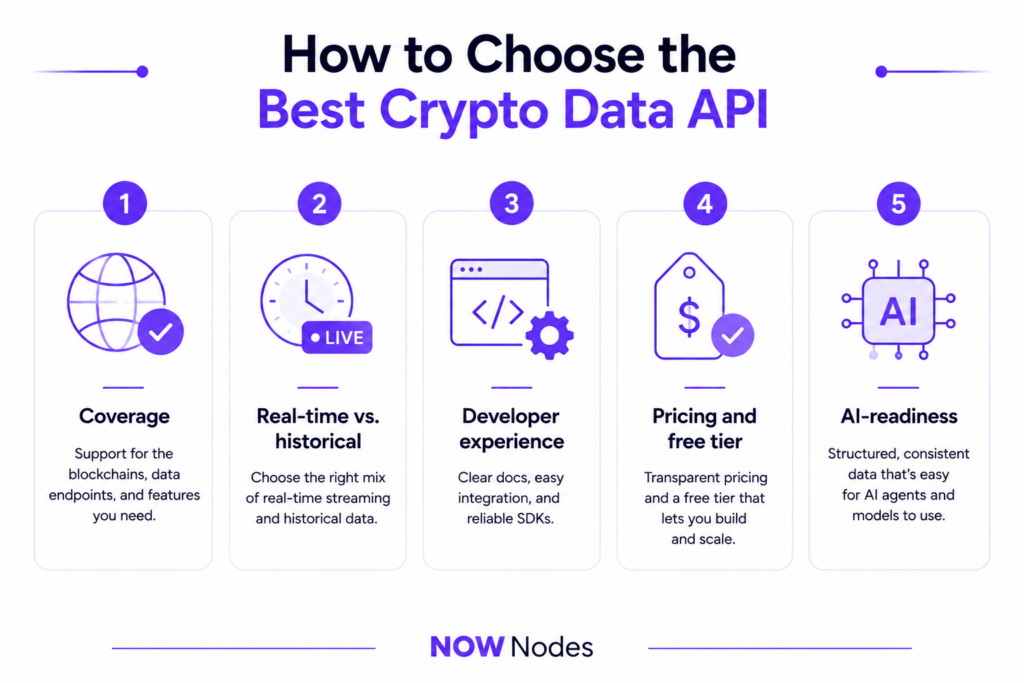
There’s no single “best” — there’s the best fit for your use case. As Chainstack’s Alex Usachev frames it in his own 2026 roundup, the smart first move is to pin down which data layer your product needs before you compare providers at all; size is the wrong opening question. Define that layer first, and the shortlist narrows itself. Five factors separate a good match from a painful one:
- Coverage — how many coins, exchanges, and chains a provider tracks. Broad coverage matters most for discovery tools and anything reaching past the top 1,000 coins into long-tail tokens.
- Real-time vs. historical — refresh rate, WebSocket streaming for live data, and how many years of history you can pull for backtesting.
- Developer experience — documentation quality, SDKs, and how fast you can get from signup to first working request.
- Pricing and free tier — whether a free plan can actually carry a prototype, and where paid pricing starts once you scale.
- AI-readiness — whether the API ships an MCP server. MCP, the Model Context Protocol, is an open standard that lets AI assistants like Claude and Cursor connect to external data sources directly — a genuine differentiator now that so many products are agent-driven.
A quick gut check before you commit: pull data for a token you already know well and verify the numbers match reality. Accuracy problems show up fast when you test against something familiar.
The 6 Best Crypto APIs in 2026
The picks below run from beginner-friendly general-purpose APIs up to specialized institutional tools. Coverage figures and pricing change often, so confirm the current details on each provider’s site before you build.
| Crypto API | Coverage | Free plan | Best for |
|---|---|---|---|
| NOWMarket API (NOWNodes) | 9,000+ coins, 90+ fiat currencies | Yes | Wallets, bots, analytics, fiat pricing |
| CoinStats API | 100,000+ assets, 120+ chains, 10,000+ DeFi protocols | Yes | All-in-one apps, portfolio + DeFi, AI agents |
| CoinMarketCap API | 10,000+ coins, 790+ exchanges | Yes (30 endpoints) | Rankings and reference data |
| CoinGecko API | 17,000+ coins, 1,700+ exchanges, 250+ networks | Yes (10k calls/mo) | General-purpose, broadest coverage |
| Messari API | 40,000+ assets, 210+ exchanges | Free account | Institutional research and diligence |
| CoinAPI | 19,000+ assets, 405 exchanges, 14+ yrs history | Trial credits | Quant work, backtesting, order books |
1. NOWMarket API by NOWNodes
The NOWMarket API is built for teams that need accurate price and fiat data without stitching together multiple providers. It delivers real-time and historical market data on 9,000+ cryptocurrencies and 90+ fiat currencies, refreshed every few seconds, with rates aggregated across major exchanges including Binance, KuCoin, OKX, and Gate.io.
Through one set of endpoints you get live prices, market cap, trading volume, and exchange rates. That combination makes it a natural fit for wallets that display balances in a user’s local currency, trading bots, analytics dashboards, and portfolio trackers — anywhere a fast, dependable price feed is the backbone.
The honest tradeoff: NOWMarket focuses on market and fiat data rather than deep DEX indexing or the millions of long-tail tokens some aggregators chase. For the vast majority of price-driven apps, that focus is the point, not a limitation. A free tier lets you prototype before committing, and stock-market data is on the roadmap for teams that span both crypto and traditional assets.
2. CoinStats API
CoinStats takes a different angle: instead of one data type, it bundles several. The CoinStats API covers market data on 100,000+ assets, wallet balances across 120+ blockchains, live positions across 10,000+ DeFi protocols, and portfolio analytics — all through a single integration.
This is the one to look at when your product needs context beyond price. Think AI trading assistants, portfolio dashboards, and multi-chain trackers that need to reason about a user’s actual holdings, not just market movements. It also ships an MCP server, so it plugs into AI agent workflows out of the box, and it’s production-tested — the same API powers CoinStats’ consumer app with over a million monthly users.
The tradeoff is breadth over depth: a single-category specialist will go deeper in its niche, and CoinStats isn’t tuned for ultra-low-latency execution. But for teams that would otherwise juggle three or four subscriptions, consolidating into one API is usually cheaper and simpler.
3. CoinMarketCap API
CoinMarketCap remains one of the most recognized names in crypto data, and its API reflects that reach. It aggregates data on 10,000+ listed coins (plus millions of on-chain DEX tokens) from 790+ exchanges, with most endpoints refreshing every 60 seconds.
The free plan covers price tracking, market cap, and rankings, though it gates you to 30 of the available endpoints — the full set unlocks on higher tiers, and paid plans also start around $35/month. WebSocket streaming is reserved for Enterprise customers, which is a real consideration if you need live push data rather than polling.
It’s a solid, familiar choice for market rankings and reference data, especially if your team already works inside the CoinMarketCap ecosystem. Just map your endpoint needs to the right tier before you build, so a missing method doesn’t surprise you mid-integration.
4. CoinGecko API
If you want the broadest general-purpose coverage, CoinGecko is hard to beat. The world’s largest independent crypto data authority since 2014, it tracks 17,000+ coins across 1,700+ exchanges and 250+ networks, and it’s trusted by names like MetaMask, Coinbase, and Etherscan.
What makes it a strong starting point is accessibility. There’s a keyless public endpoint for instant testing, a free Demo plan with 10,000 monthly calls, and paid plans starting at just $35/month — the most affordable commercial license among the major providers. You also get 70+ endpoints, up to 12 years of historical data, and an MCP server for AI tooling.
Here’s the nuance worth knowing: CoinGecko is an aggregator, not a per-exchange feed. It normalizes data across venues rather than serving raw tick-level order books from a single exchange. For most apps that’s a feature. For microsecond trading systems, it isn’t the right layer.
5. Messari API
When the work is research rather than a consumer app, Messari is the institutional benchmark. Its API spans 15+ data families — market data, on-chain metrics, news, fundraising, token unlocks, and AI-powered research — across 40,000+ assets and 210+ exchanges.
What sets it apart is the analytical layer. Messari standardizes data trusted by exchanges, asset managers, and funds, carries SOC 2 Type II certification, and even distributes protocol data to terminals like Bloomberg and S&P Global. You can start with a free account for news and basic metrics, then move to Enterprise for diligence reports, monitoring, and custom API access.
Be clear-eyed about fit, though. Messari is built for analysts, researchers, and institutions doing deep fundamental work — its depth can overwhelm anyone who just needs simple price tracking. If diligence and governance data are your priority, few tools match it.
6. CoinAPI
For quantitative teams, CoinAPI is purpose-built. Its standout feature is historical depth: 14+ years of tick-level data across 19,000+ assets and 405 exchanges, with full Level 2 and Level 3 order book resolution. That’s the kind of archive that takes serious infrastructure to maintain.
Delivery options match the audience — REST, WebSocket, the FIX protocol for institutional systems, and flat-file downloads for bulk pipelines. The developer tier starts at $79/month, and the documentation assumes you know what you’re after rather than walking you through a ten-minute quickstart.
The catch is scope. CoinAPI is centralized-exchange-focused, so there’s no wallet tracking, DeFi, or on-chain analytics here, and the pricing adds up for smaller teams. For backtesting and execution-system work, it’s excellent; for a simple price feed, it’s overkill.
Also Worth Knowing
A few specialized crypto APIs come up often without quite making the core six. Glassnode is the institutional standard for on-chain analytics, with 7,500+ metrics and entity-adjusted data across 1,200+ assets. CoinDesk Data (formerly CryptoCompare) offers deep trade-level data from 300+ exchanges alongside market news. Bitquery indexes 40+ chains behind flexible GraphQL queries for custom on-chain questions, while Covalent covers 200+ networks through a single unified schema. Each is worth a look if it maps to a workflow you already run.
Free vs. Paid Crypto APIs: What to Expect
Most leading crypto data APIs are free to start — but “free to start” and “free to run at scale” are two different things. Nearly every provider here offers a free tier, and for a prototype or a small project, those tiers genuinely work. CoinGecko’s 10,000 monthly calls or NOWNodes’ free plan can carry real early-stage builds.
The gap shows up as you grow. Free plans cap your monthly calls, limit endpoint access, restrict WebSocket streaming, or shorten historical depth. When traffic climbs, paid plans open up — often starting around $35/month for entry tiers and rising with call volume, real-time data, and commercial licensing.
Here’s the practical rule: match the plan to your actual request pattern, not your ambitions. A portfolio tracker refreshing every 30 seconds has very different needs than a trading dashboard demanding sub-second streams. Estimate your calls per minute honestly before you pick a tier, and you’ll avoid both overpaying and hitting a wall.
How to Get Started With a Crypto API
Getting from zero to your first live price is usually quick. The sensible path looks like this:
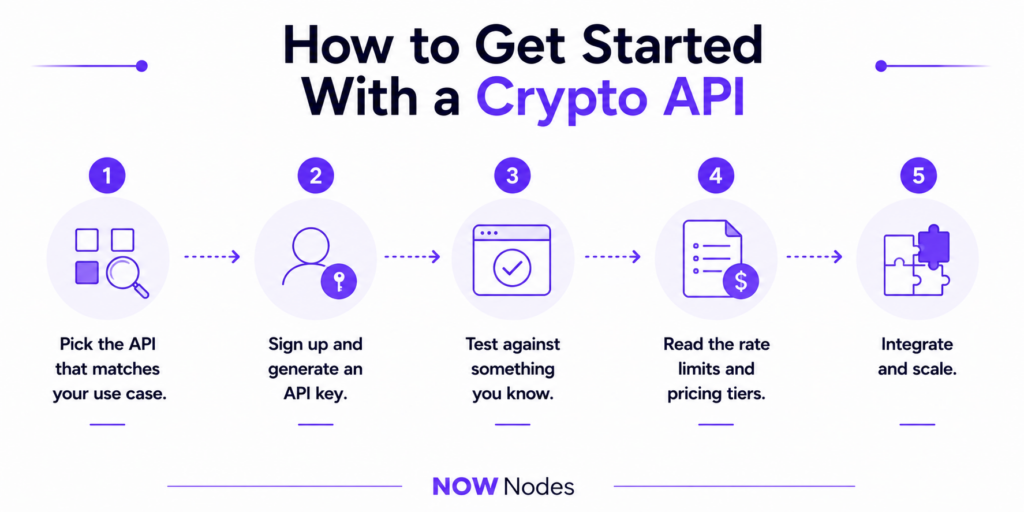
- Pick the API that matches your use case. A general app is well served by NOWMarket, CoinGecko, or CoinMarketCap; a portfolio-and-DeFi product leans toward CoinStats; a research tool points to Messari.
- Sign up and generate an API key. Most providers issue one from a dashboard in under a minute, and many offer keyless testing so you can experiment before registering.
- Test against something you know. Query a familiar token and confirm the price, volume, and market cap line up with reality before you wire it into anything.
- Read the rate limits and pricing tiers. Know your monthly call cap and which endpoints your plan unlocks, so nothing surprises you later.
- Integrate and scale. Wire the endpoints into your app, monitor your usage, and move to a paid tier when your call volume approaches the free-plan ceiling.
One habit pays off long-term: build a thin abstraction layer between your app and the API. If you ever need to switch providers, you’ll change one module instead of rewriting your entire codebase.
Conclusion
The best crypto API in 2026 isn’t the one with the biggest numbers on its homepage — it’s the one whose data layer matches what you’re building. General-purpose apps are well served by NOWMarket, CoinGecko, or CoinMarketCap; all-in-one products that need portfolio and DeFi context lean toward CoinStats; research and quant teams reach for Messari and CoinAPI.
The through-line is the one experienced developers keep landing on. Define the data you actually need first, verify a provider’s accuracy against tokens you know, respect the free-tier limits, and keep your integration loosely coupled so you can switch later. Do that, and the right crypto data API becomes the quiet, reliable foundation your product is built on — which is exactly what it should be.
FAQ
What is a crypto API?
A crypto API is a service that lets your software request cryptocurrency data — prices, market cap, volume, historical charts — through simple calls, without gathering and maintaining that data yourself. You send a request to an endpoint and get back structured data your app can display or process.
What is the difference between a crypto data API and a blockchain infrastructure API?
A crypto data API aggregates market data from exchanges into ready-to-use price and volume feeds. A blockchain infrastructure API connects directly to a chain to read on-chain state and submit transactions. Data APIs suit price tracking and analytics; infrastructure APIs suit contract writes and wallet operations. Many products use both.
What is the best crypto API for beginners?
CoinGecko and CoinMarketCap are common first picks — both offer free tiers, broad coverage, and simple documentation. NOWMarket API is also beginner-friendly when you need reliable price and fiat data. Each lets you start testing without payment.
Are crypto APIs free?
Most leading crypto data APIs are free to start, with plans that cap monthly calls, endpoints, or historical depth. Free tiers comfortably cover prototypes and small projects. Paid plans, often starting around $35/month, unlock higher limits, real-time streaming, and commercial licensing as you scale.
Which crypto API has the most coverage?
Among general-purpose providers, CoinGecko tracks 17,000+ coins across 1,700+ exchanges and 250+ networks. For aggregated multi-layer coverage, CoinStats spans 100,000+ assets and 10,000+ DeFi protocols, while Messari covers 40,000+ assets with a research focus. The right choice depends on whether you need breadth of coins, DeFi context, or research depth.
What is an MCP server, and why does it matter for crypto APIs?
MCP (Model Context Protocol) is an open standard that lets AI assistants connect directly to external data sources. A crypto API with an MCP server can feed live market data straight into AI agents built on tools like Claude or Cursor, which is increasingly valuable as more products become agent-driven.
How do I choose the best crypto data API for my project?
Match five factors to your use case: coverage (coins, exchanges, chains), real-time vs. historical needs, developer experience, pricing and free-tier limits, and AI-readiness. Define the data your product actually needs first, then verify a provider’s accuracy against a token you already know before committing.