
A free public BNB Smart Chain endpoint is a shared RPC URL that anyone can point a wallet, script, or dApp at to read chain data or broadcast a transaction, with no signup and no API key. It’s the fastest way to touch BNB Smart Chain (BSC) for the first time, and also the easiest way to get throttled the moment a project outgrows a hobby project. Here’s what these endpoints actually are, who they work for, and where they run out of road.
What Is a Public BNB Smart Chain Endpoint?
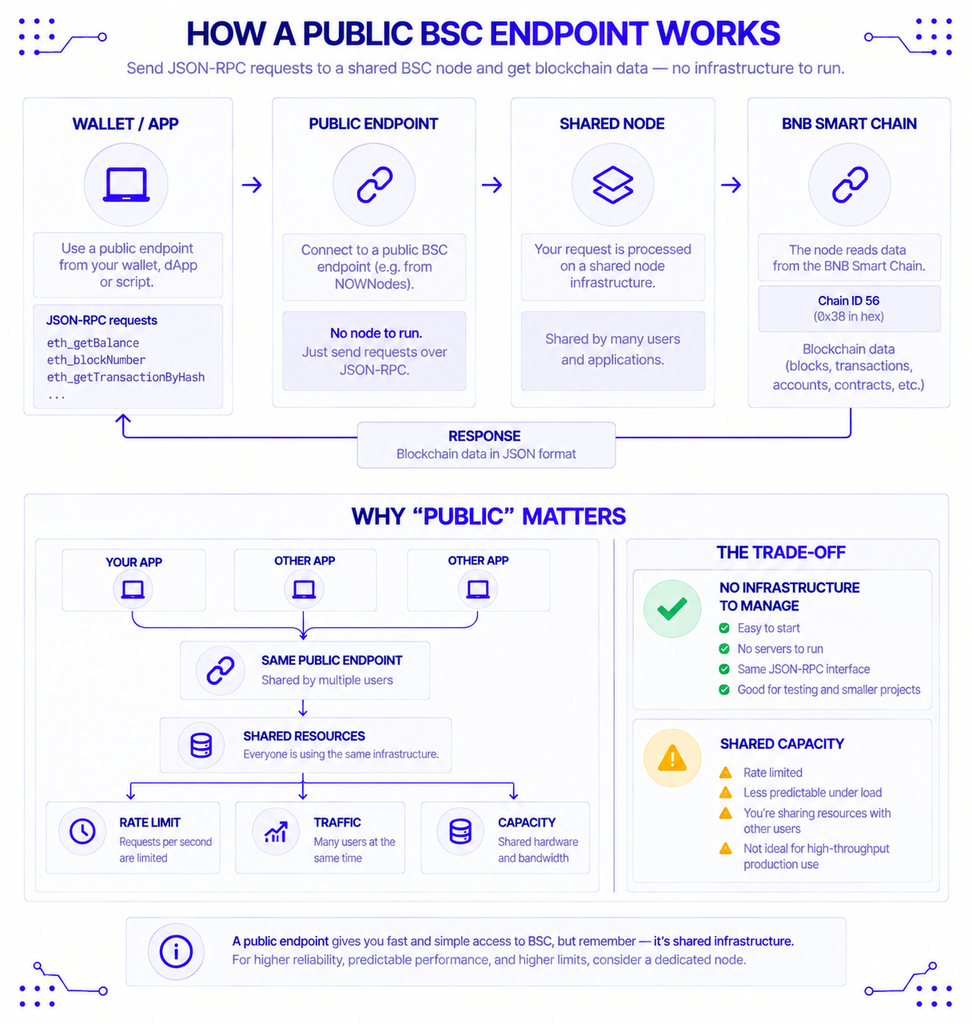
A public endpoint is a BSC node someone else runs and opens up for shared, usually rate-limited, use. Your app talks to it the same way it would talk to a paid node: over JSON-RPC, the same request format Ethereum uses, since BSC is EVM-compatible.
Point a wallet or script at the URL, and it can call standard methods like eth_getBalance or eth_blockNumber without you running any server-side infrastructure. The endpoint identifies BSC mainnet by chain ID 56 (0x38 in hex); testnet uses chain ID 97.
The trade-off is right there in the word “shared.” You’re using someone else’s hardware, and everyone else hitting that same URL is competing for the same request budget.
Why Do Free Public Endpoints Exist?
Running a full BSC node isn’t trivial. It needs roughly 2–2.5 TB of storage and one to two days to sync from scratch, according to RPC Fast’s 2026 node guide — a real barrier for anyone who just wants to check a balance or test a contract call.
Free public endpoints remove that barrier. BNB Chain itself publishes a set of public mainnet URLs, and infrastructure providers like NOWNodes, PublicNode, and Ankr run their own, precisely so a developer can start building before deciding whether the project needs paid infrastructure at all.
It’s also an acquisition strategy. Auston Bunsen, co-founder of QuickNode, noted in an interview with Sacra that providers offering no-signup access are “presumably just getting a bunch of people that are making use of their service and not paying them” — free tiers exist to get developers in the door, with the expectation that serious, high-volume usage eventually needs a paid plan.
Who Actually Uses Free Public BNB Endpoints?
The common thread is low, occasional traffic rather than a specific job title.
- Students and hobbyist developers learning how to read BSC state or send a test transaction without setting up an account anywhere.
- Hackathon and MVP teams who need a working endpoint in the next five minutes, not after a signup flow.
- Wallet and dApp developers during local development and testnet work, before any real user traffic exists.
- Scripts and bots that check a balance or a contract value occasionally rather than continuously.
- Anyone verifying a claim — confirming a transaction went through, or a contract address is what it claims to be — without building anything permanent.
None of these are production workloads. The moment real users, real money, or continuous polling enter the picture, the calculus changes — more on that below.
How to Connect to a Free BNB Smart Chain Endpoint
Adding a public endpoint to a wallet or app takes the same handful of steps regardless of provider.
- Pick an endpoint URL from BNB Chain’s official list or a provider such as NOWNodes or PublicNode.
- Open your wallet’s network settings (in MetaMask: Settings → Networks → Add Network).
- Enter the RPC URL, chain ID
56, currency symbolBNB, and a block explorer URL such ashttps://bscscan.com. - Save the network and switch to it.
- Send a test call, like checking a balance, to confirm the endpoint responds.
For a script rather than a wallet, the same URL works as the provider argument in a library like ethers.js or web3.py — no key, no header, no account required.
Comparing Free Public BNB Endpoints in 2026
Every free option makes a different trade between simplicity, privacy, and throughput.
| Provider | Signup Required | Typical Limit | Notable Feature |
|---|---|---|---|
| BNB Chain official endpoints | No | 10,000 requests / 5 min per IP, shared | Direct from the chain’s own infrastructure; eth_getLogs is disabled |
| NOWNodes public endpoint | No | 5 requests per second | One URL structure shared with 120+ other networks |
| PublicNode | No | Not publicly capped, best-effort | MEV-protected relay, archive data and WebSocket both available |
| 1RPC | No | Best-effort | Strips identifying headers before forwarding requests |
| Ankr public RPC | No | Credit-based, shared pool | Same endpoint pattern reused across 75+ chains |
| GetBlock free tier | Yes, API key | Request-capped free plan | Adds a dashboard and basic usage analytics |
BNB Chain’s own documentation lists seven mainnet URLs — including bsc-dataseed.bnbchain.org and bsc-dataseed.ninicoin.io — and caps each IP at 10,000 requests every five minutes, which works out to roughly 33 requests per second on average, though bursts get throttled faster than that average suggests. That same documentation disables eth_getLogs on the official endpoints entirely and points developers toward a third-party provider or WebSocket subscription for log-heavy workloads.
NOWNodes runs a public BSC endpoint at public-bsc.nownodes.io with a flat 5 requests-per-second limit and no signup — a lower ceiling than BNB Chain’s own nodes, but it comes bundled with the same URL structure NOWNodes uses across 120+ other networks, which matters if a project needs BSC today and another chain next month.
What Are the Real Limits of a Free Endpoint?
Rate limiting is the most visible ceiling, but it isn’t the only one.
Public nodes carry no service-level agreement, so they can go offline without warning, and some aren’t kept perfectly in sync — meaning a request can return slightly stale chain state. There’s also a trust question: a public node operator controls what your app sees, and a misconfigured or bad-faith node could, in principle, return manipulated data or drop your transaction before it’s broadcast.
Privacy is the quieter issue. Every request to a public endpoint reveals your app’s IP and usage pattern to whoever runs that node — irrelevant for a balance check, more relevant for a trading bot whose request timing hints at its strategy. Providers like 1RPC exist specifically to strip that identifying information before forwarding a request.
None of this makes free endpoints unsafe for their intended job. It makes them unsuitable for anything where downtime, stale data, or exposed traffic patterns would actually cost you something.
When Should You Move Beyond a Free Public Endpoint?
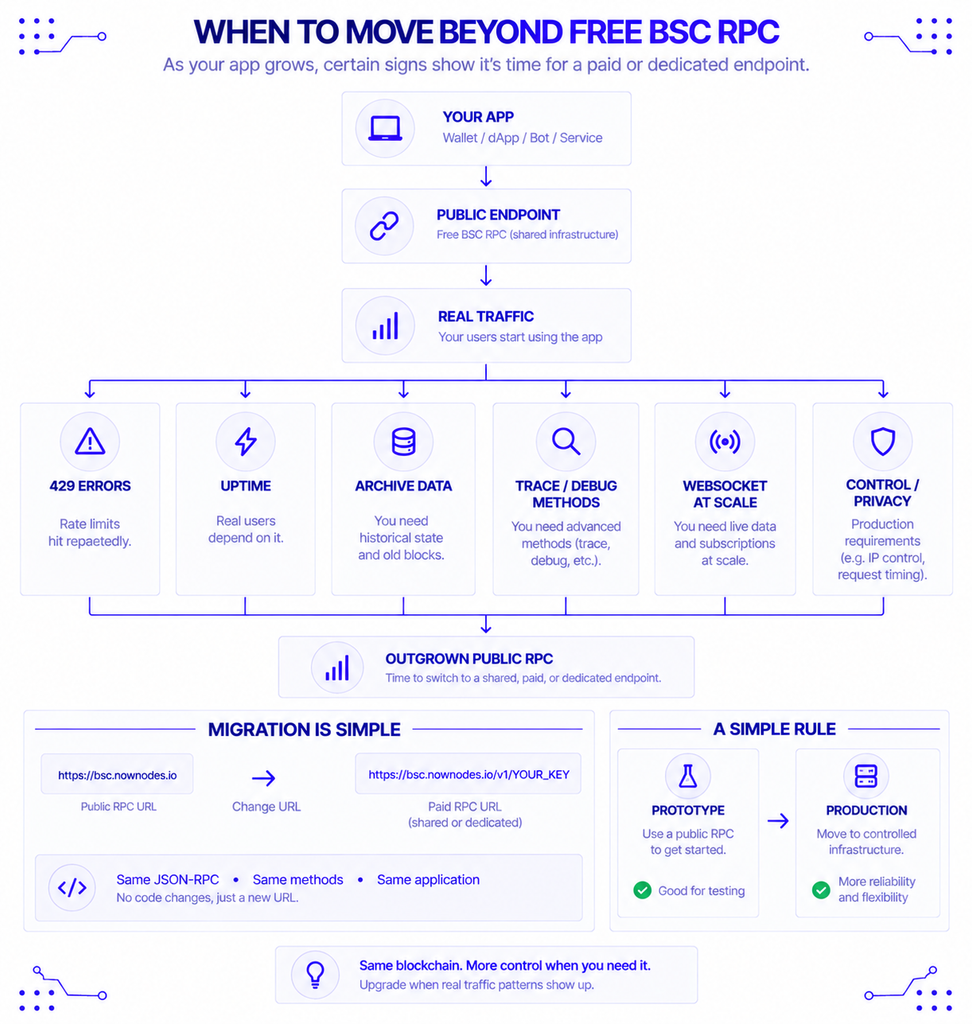
A few concrete signals mean it’s time to look at a paid or dedicated option instead of stretching a free one further:
- You’re hitting rate limits regularly. Repeated
429errors mean the app has outgrown shared infrastructure, not that you need a cleverer retry loop. - Real users depend on uptime. A wallet or exchange feature that breaks when a public node goes down is a support ticket waiting to happen.
- You need archive data or Trace/Debug methods. These are rarely exposed on free public nodes and usually require a provider’s shared or dedicated plan.
- You need WebSocket subscriptions at scale. Free WebSocket access, where available at all, is typically the first thing throttled under load.
- Request timing or IP exposure matters to your use case. A production trading system generally shouldn’t route through infrastructure it doesn’t control.
Migration itself is the easy part. Because BSC speaks standard JSON-RPC, switching from a free endpoint to a paid one is usually a one-line URL change rather than a rewrite — the same reason it’s fine to prototype on a free endpoint in the first place and upgrade only once real traffic patterns show up. NOWNodes’ BSC node page and the Ethereum-vs-BSC comparison cover what a dedicated or shared paid node adds once that point arrives.
Free vs. Paid: What Actually Changes
| Area | Free Public Endpoint | Paid Shared/Dedicated Node |
|---|---|---|
| Rate limit | Single digits to low tens of RPS | Plan-based, up to no predefined cap on dedicated |
| Uptime guarantee | None | Provider SLA, often 99.9%+ |
| Archive & historical data | Rarely available | Available on supporting plans |
| Trace/Debug methods | Usually disabled | Available where the network supports them |
| Support | None | Included with paid plans |
| Best fit | Prototyping, testnets, occasional reads | Production apps, real users, continuous traffic |
Conclusion
A free public BNB Smart Chain endpoint is exactly what it sounds like: a no-cost, no-signup way to read chain state or send a transaction, built for the exploration phase of a project rather than its production phase. Use one to learn, prototype, and test — BNB Chain’s own endpoints, NOWNodes, PublicNode, 1RPC, and Ankr all cover that job well, each with a slightly different take on rate limits and privacy.
The moment your app has real users, needs archive data, or simply can’t afford a 429 error at the wrong time, that’s the signal to move to a paid plan — not because the free option failed, but because it was never built for that job in the first place.
FAQ
Is it safe to use a free public BNB endpoint in production?
Not for anything that depends on uptime or real user funds. Free endpoints carry no SLA and can go offline or return outdated data without warning, so they’re better suited to development and low-stakes reads.
Do I need an API key for a free public BSC endpoint?
Most don’t require one — BNB Chain’s official URLs, NOWNodes’ public endpoint, PublicNode, and 1RPC all work without signup. GetBlock is the exception among common options, requiring an API key even on its free tier.
Why do my requests fail with a 429 error on a free endpoint?
A 429 means you’ve exceeded that endpoint’s rate limit, whether that’s BNB Chain’s 10,000-requests-per-five-minutes cap or a provider’s flat RPS limit. It’s a signal to slow your request rate or move to a paid plan, not a bug to work around with retries.
Can I use a free public endpoint to send transactions, not just read data?
Yes. A standard JSON-RPC endpoint supports both reads (like eth_getBalance) and writes (like eth_sendRawTransaction), as long as you sign the transaction locally first. The endpoint never needs your private key.
Is there a free BNB Smart Chain testnet I can use before mainnet?
Yes. BNB Chain publishes dedicated testnet RPC URLs at chain ID 97, and testnet BNB is available from public faucets, so contracts and integrations can be tested without spending real funds.