

A crypto exchange is a platform where you convert cash into cryptocurrency, trade one coin for another, and hold the balance until you’re ready to move it. It works like a brokerage built for digital assets: you fund an account, place an order, and the platform matches it against someone else’s.
That single function makes exchanges the entry point for almost everyone who owns crypto. Some of the world’s largest crypto exchanges — Binance, Coinbase, OKX, Kraken, and a handful of others — together processed roughly $2.7 trillion in spot trading volume in the first quarter of 2026 alone, according to market-share data from CoinLaw. The top four accounted for about 68% of all 2025 spot volume, which shows how concentrated this market really is.
This guide ranks the 10 best crypto exchanges by volume, security, and longevity, then goes past the leaderboard: what actually makes one platform safer than another, why trading volume alone can mislead you, and how regulation now decides who’s even allowed to operate.
What Is a Crypto Exchange?
Crypto exchange is a company-operated platform that matches cryptocurrency buyers and sellers, custodies their funds in exchange-controlled wallets, and settles most trades on an internal ledger rather than directly on a blockchain for every single order.
Place a trade on one of the major cryptocurrency exchanges and it rarely touches the blockchain in real time. The matching engine pairs your buy order with someone else’s sell order and updates its own database instantly — the blockchain only gets involved when you deposit funds in or withdraw them out. That’s what lets these platforms handle millions of trades a day.
It’s also what separates a centralized, custodial exchange from a decentralized one. On a DEX, smart contracts execute every trade directly on-chain and you keep control of your funds throughout. Most people still start on a centralized platform anyway, since it bundles a fiat on-ramp, customer support, and a familiar buy/sell screen that a DEX doesn’t offer.
Why Crypto Exchanges Exist
Two strangers who want to trade Bitcoin for Ethereum have no easy way to find each other, agree on a fair price, and settle the trade safely. An exchange solves that by pooling thousands of buy and sell orders into one order book, so a trade executes in seconds instead of requiring you to hunt down a counterparty yourself.
That pooled order flow is also where crypto prices actually come from. The Bitcoin price quoted on any app or news site is aggregated from live order books across major exchanges — CoinGecko’s trust score methodology, for instance, draws on roughly 600 of the highest-volume trading pairs rather than trusting any single venue.
This is why exchange choice matters more than it looks. A platform with thin order books can show a price that evaporates the moment you actually try to trade at size — a problem covered in more depth further down.
Who Actually Uses Crypto Exchanges?
Exchanges serve a wider range of people than the trading-floor image suggests. Four groups make up most of the activity:
- Beginners and retail investors use an exchange as their first, and often only, way to convert a bank transfer into Bitcoin, Ethereum, or another asset.
- Active traders rely on margin, futures, and built-in copy trading tools that mirror an experienced trader’s positions automatically.
- Institutions move size that retail apps aren’t built for — Coinbase alone processed $166 billion in institutional trading volume in Q1 2026, 82% of everything that traded on the platform, per CoinLaw’s data.
- Developers and businesses query exchange and blockchain data to power portfolio trackers, tax tools, and payment systems that need live prices and balances.
Passive holders form a quieter fifth group: many just leave coins on an exchange and opt into staking, letting the platform run the validator on their behalf for a cut of the reward.
Ranking the 10 Largest Platforms
The ranking below leans on 2025–2026 spot market share where it’s available, backed up by security track record and how long each platform has operated without a fund-threatening failure. Size alone doesn’t make a platform trustworthy, but it’s still the first filter most people use when comparing the biggest crypto exchanges worth their attention. Market share shifts quarter to quarter, so treat the order as a snapshot, not a permanent hierarchy.
| Rank | Exchange | Best For | Founded | Standout Metric |
|---|---|---|---|---|
| 1 | Binance | Overall liquidity | 2017 | 39.2% spot market share |
| 2 | Coinbase | US-regulated access | 2012 | 8.6% spot share; public company |
| 3 | OKX | Derivatives trading | 2017 | Led monthly derivatives volume, Sept. 2025 |
| 4 | Bybit | High-volume futures | 2018 | 8.1% spot market share |
| 5 | Kraken | Security track record | 2011 | 94/100 exchange safety score |
| 6 | MEXC | Altcoin selection | 2018 | 7.8% spot market share |
| 7 | Gate | Early token access | 2013 | 7.5% spot market share |
| 8 | Bitget | Copy trading | 2018 | 122% reserve ratio |
| 9 | KuCoin | Asset variety | 2017 | Recovered 78% of 2020 hack losses |
| 10 | Crypto.com | Mobile app and card | 2016 | Consumer-facing Visa card program |
1. Binance
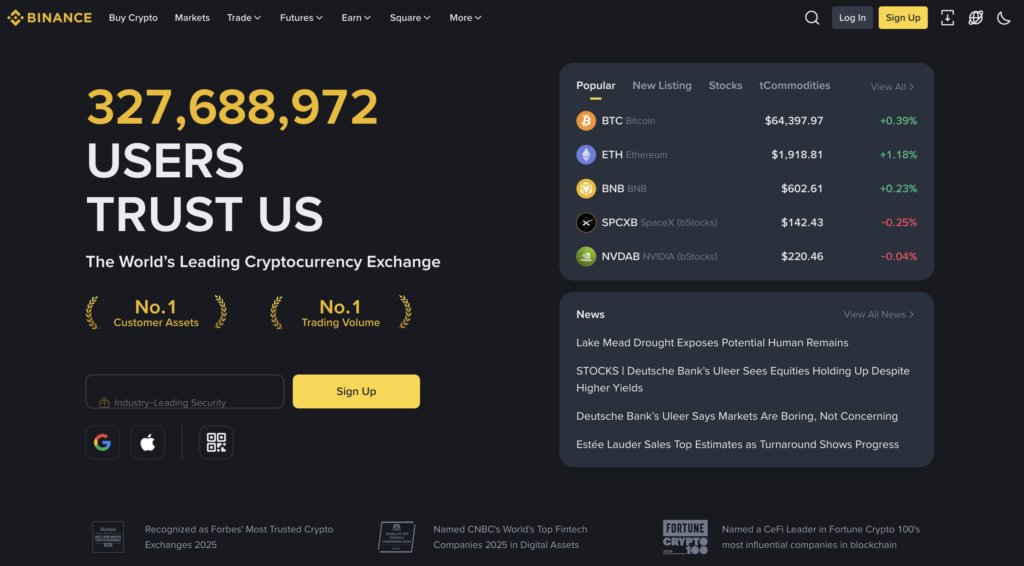
Binance has led every major exchange ranking by volume since 2018, holding 39.2% of 2025 spot trading — more than four times its nearest rival. Founded by Changpeng Zhao in 2017 and now run by CEO Richard Teng, it lists over 1,600 trading pairs. Its SAFU insurance fund held roughly 15,000 BTC as of February 2026, built after a 2019 hack cost it 7,000 BTC, and Coin Bureau scores it 85/100 for safety.
2. Coinbase
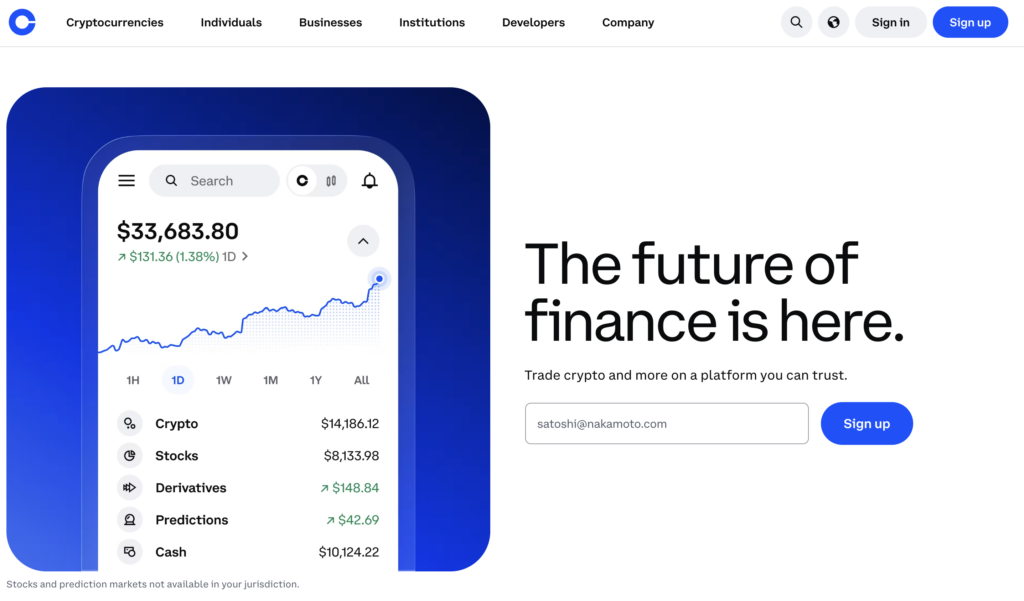
Coinbase is the default choice for most US traders and the only exchange here that’s publicly traded. It listed on Nasdaq under ticker COIN in April 2021, closing its debut at $328.28 a share for an $85.8 billion valuation. That public listing means SEC filings, not a Merkle-tree proof, are how it demonstrates solvency — it reported $8.614 billion in cash and equivalents as of June 2026.
3. OKX
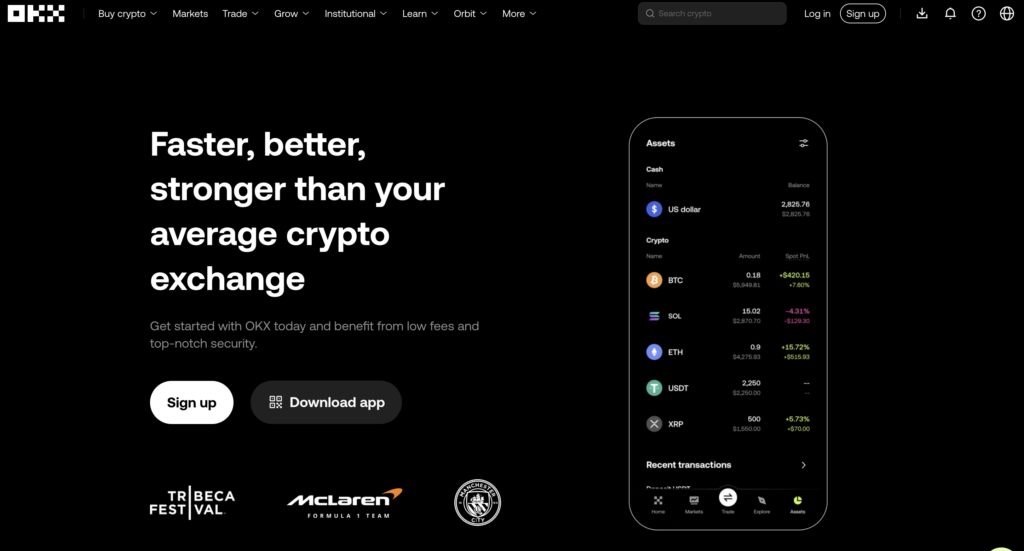
OKX is a leading derivatives platform rather than a spot-trading specialist, having overtaken Binance for monthly derivatives volume in September 2025 with $1.3 trillion traded. Originally launched as OKEx in 2017, it suits traders who want deep futures and options markets alongside standard spot pairs.
4. Bybit
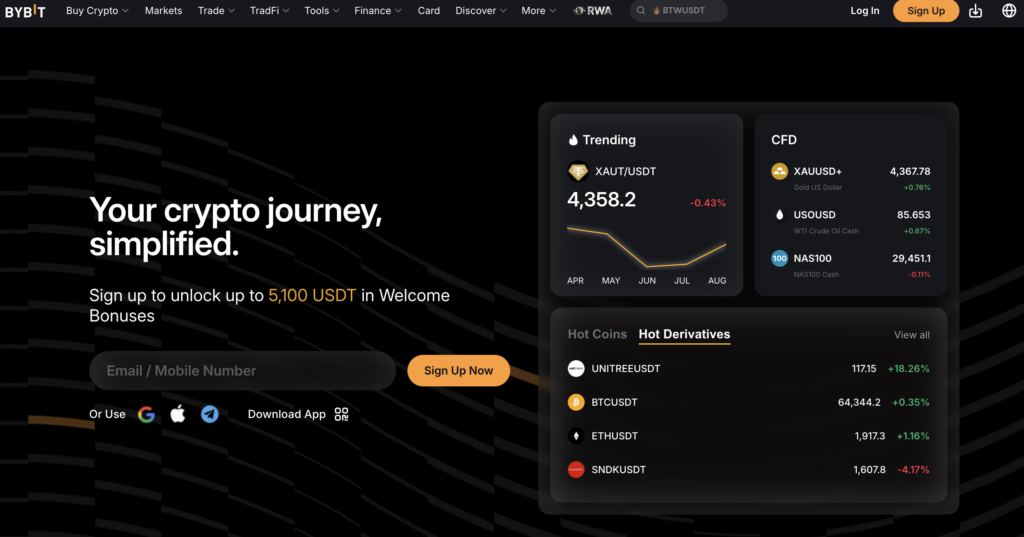
Bybit has carved out a similar niche to OKX, built around fast, high-leverage futures trading since its 2018 launch. Its 8.1% share of 2025 spot volume sits just behind Coinbase, and it’s become one of the more popular platforms for exchange-native copy trading.
5. Kraken
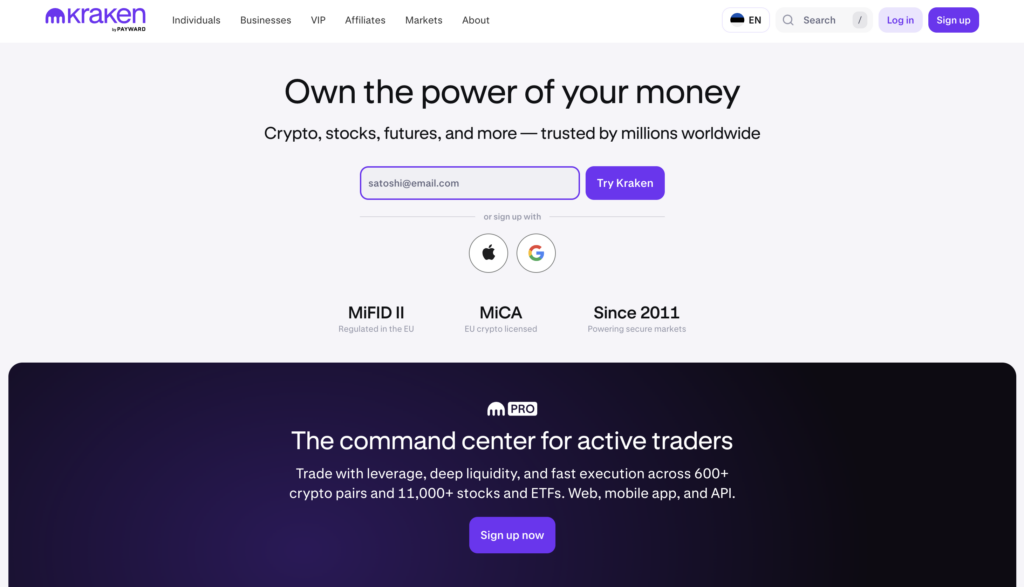
Kraken is the oldest exchange on this list, operating continuously since 2011 — it outlasted the Mt. Gox era that killed off most of its early competitors. That track record shows in Coin Bureau’s scoring: 94 out of 100, the highest of any exchange it reviewed, backed by reserve ratios of 101.6% for Bitcoin and 100.9% for Ethereum as of March 2026.
6. MEXC
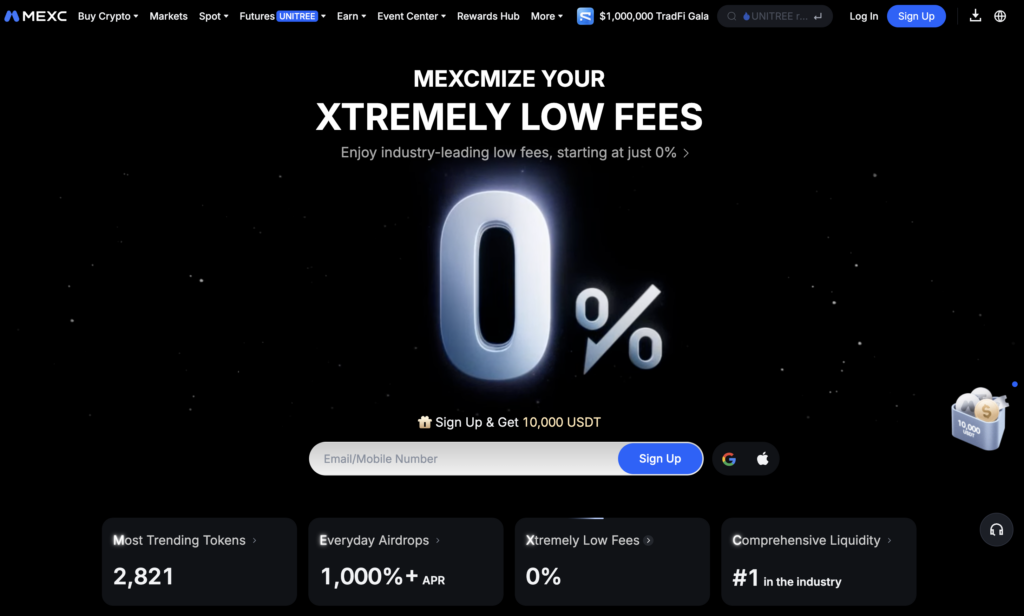
MEXC holds 7.8% of 2025 spot volume and built its identity on listing new, smaller tokens faster than larger rivals will. Launched in 2018, it’s a common stop for traders chasing early access to a coin before it reaches Binance or Coinbase.
7. Gate
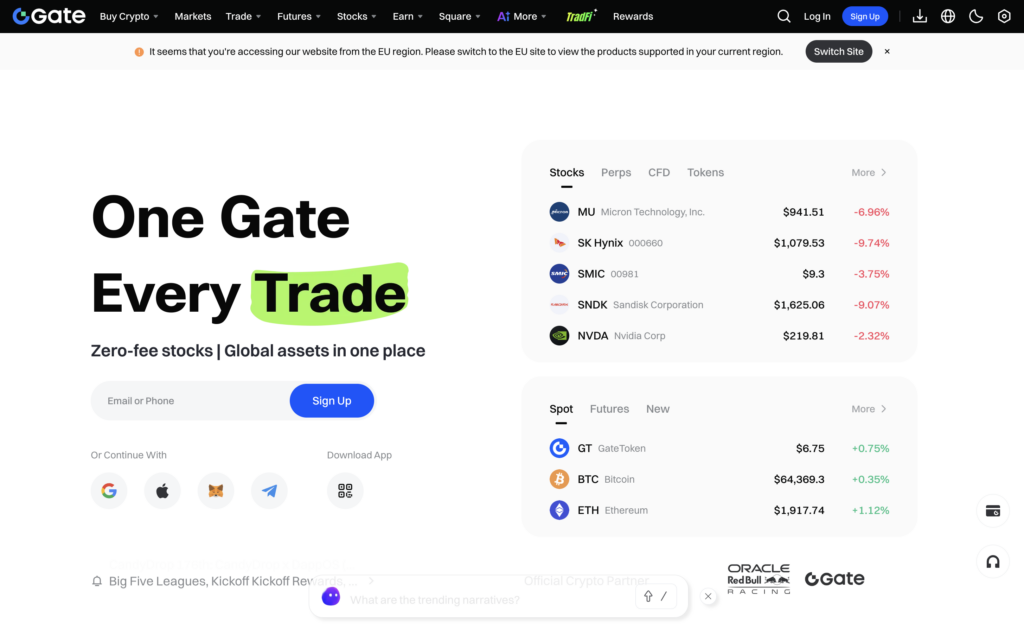
Gate has operated since 2013 and holds 7.5% of spot market share, one of the longer-running platforms still inside the top tier by volume. It’s built a reputation on a broad altcoin catalog rather than derivatives depth, closer in spirit to MEXC than to Binance.
8. Bitget
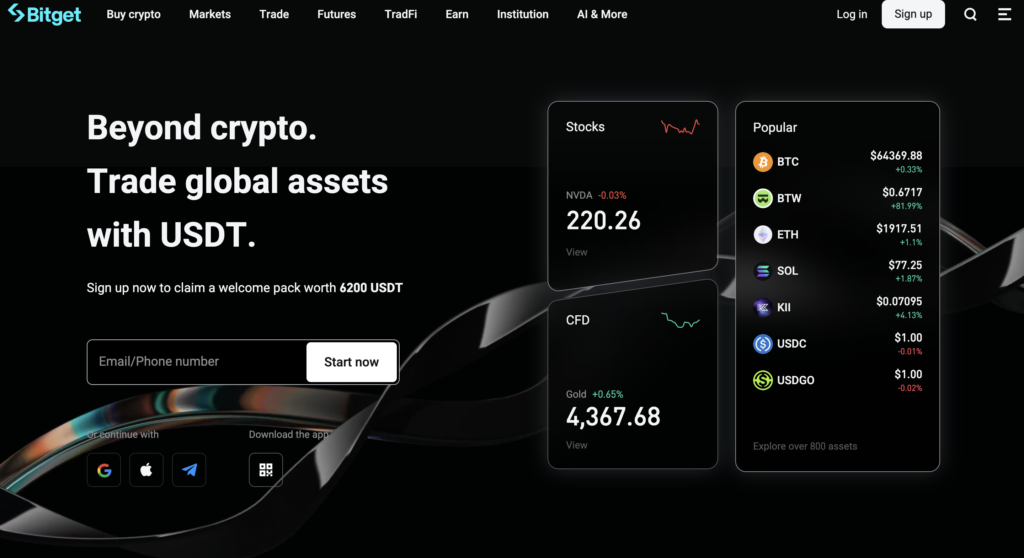
Bitget has built copy trading into its core product rather than treating it as an add-on, backed by a 122% total reserve ratio as of July 2026, verified through monthly Merkle-tree updates. Founded in 2018, it scored 89/100 in Coin Bureau’s safety review — third-highest on this list.
9. KuCoin
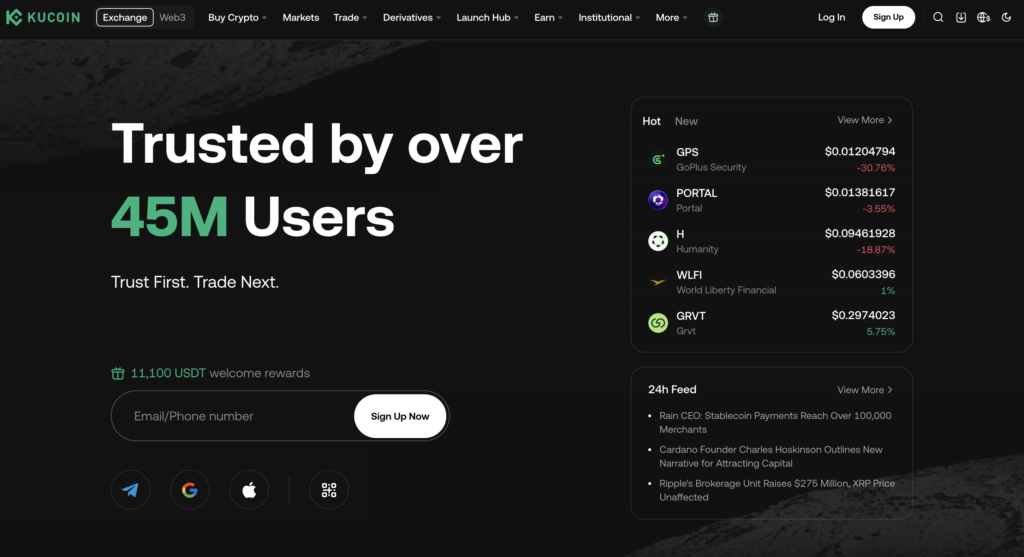
KuCoin earns its place for how it handled its worst moment as much as for its size. After a 2020 hack, it recovered $222 million — 78% of what was stolen — and kept operating instead of collapsing, later scoring 81/100 for safety. Founded in 2017, it’s since built one of the widest altcoin selections around.
10. Crypto.com
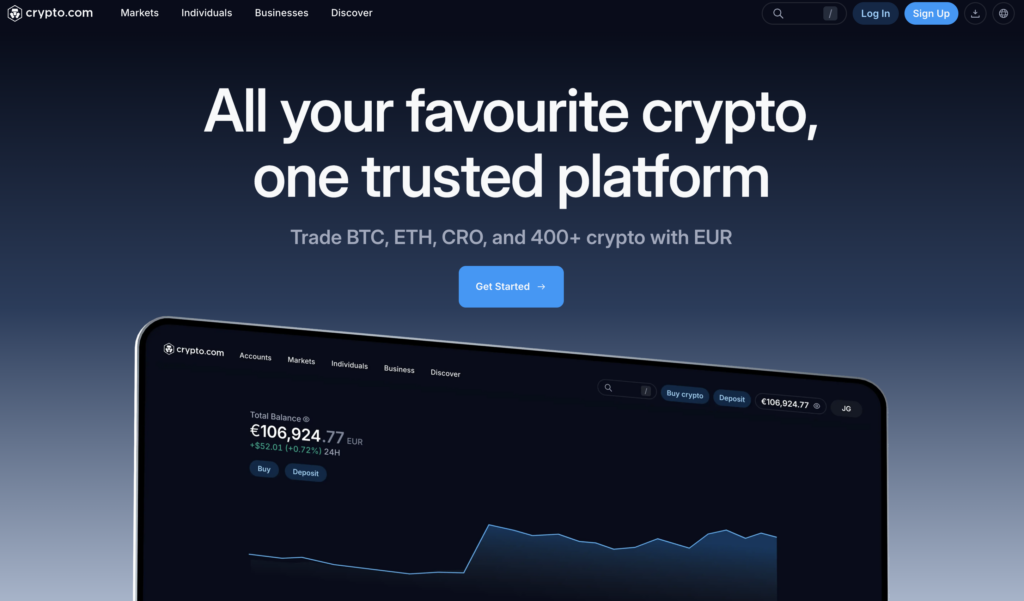
Crypto.com leans on brand recognition more than raw trading volume, built through its Visa card program and mobile app rather than a derivatives desk. Founded in 2016 as Monaco, it’s often the platform newcomers already recognize by name before they’ve compared a single fee schedule.
How to Choose a Crypto Exchange
Ranking exchanges by size answers “which platforms are biggest,” not “which one is right for you.” Three factors matter more than volume once you’re actually picking one: how well the exchange proves it holds your funds, whether its liquidity is real, and whether it’s legally allowed to serve you at all.
Security and Proof of Reserves
The FTX collapse in November 2022, which revealed roughly $10 billion in missing user funds, turned proof of reserves from a nice-to-have into an industry expectation almost overnight.
Proof of reserves is a cryptographic verification, typically using a Merkle tree, that lets an exchange demonstrate its on-chain holdings match what it owes customers without exposing any individual account’s balance. See CoinMarketCap’s glossary entry for how the audit trail works.
A reserve ratio above 100% means an exchange holds more of an asset than customers are owed; anything below that is a warning sign. Kraken (101.6% BTC) and Bitget (122% total) both publish independently verified ratios, while Coinbase demonstrates solvency through SEC filings instead of a retail-facing Merkle proof.
Liquidity Isn’t the Same as Trading Volume
A high spot-market-share number doesn’t guarantee you can actually trade at the price shown on screen. “Crypto looks liquid, until you try to trade large volumes,” Leo Mindyuk, CEO of ML Tech, told CoinDesk in February 2026.
That gap can be extreme. CoinDesk cited Amberdata figures showing a market with $103.64 million in visible order-book liquidity collapse to just $170,000 in executable depth within moments — a drop of more than 98%. Real depth within a percentage point or two of the market price matters more than the total volume printed on a ranking chart.
Regulation and Licensing
Regulatory status increasingly determines which exchanges you’re even allowed to use, not just which ones you’d prefer. In the EU, every crypto-asset service provider needed a MiCA license by December 30, 2024, and the transition window for unlicensed platforms closed entirely on July 1, 2026 — ESMA’s own statement confirms any unauthorized provider serving EU clients past that date is in breach of EU law.
The US still lacks an equivalent single framework. Exchanges there register as money service businesses under a mix of SEC and CFTC oversight depending on the asset, a patchwork that federal proposals like the CLARITY Act aim to simplify, though nothing had passed as of mid-2026.
How Exchanges Move Crypto On-Chain
Everything above happens on the exchange’s internal ledger, but deposits and withdrawals are real blockchain transactions the moment they leave that ledger. When you send Bitcoin to an exchange address or withdraw Ethereum to your own wallet, the platform’s backend has to watch that blockchain for the transaction and confirm it before crediting or releasing funds.
Doing that across every listed network means running infrastructure for dozens of separate blockchains at once, each with its own client software and sync requirements. Exchanges and payment platforms handle this either by operating that infrastructure themselves or by connecting through a provider such as NOWNodes, which offers RPC access across 120-plus networks so a platform can read balances, confirm deposits, and broadcast withdrawals without maintaining a separate node for every asset it lists.
Conclusion
There’s no single best crypto exchange, only the one that matches what you’re optimizing for. Binance and Coinbase lead on raw size and regulatory standing, Kraken and Bitget lead on verifiable security, and OKX and Bybit lead on derivatives depth — pick the metric that matters for how you actually plan to use the platform.
Reputable crypto exchanges make their reserves and licensing status easy to verify; treat any platform that doesn’t as a reason for caution, no matter how high it ranks by volume. That’s worth checking before trading volume — a platform can look dominant on a ranking chart and still be the wrong one to trust with your funds.
FAQ
Which crypto exchange is the safest?
Based on independently verified reserve data and incident history, Kraken currently scores highest on third-party safety reviews at 94/100, according to Coin Bureau’s 2026 analysis. Bitget and Coinbase follow closely, each backing their standing with public reserve or financial disclosures.
Do crypto exchanges charge trading fees?
Yes. Most charge a percentage per trade, commonly between 0.1% and 0.5% for standard spot orders, though fees vary by exchange, order type, and volume tier. Orders that add liquidity typically cost less than orders that remove it.
Can you use a crypto exchange without ID verification?
Rarely, on any major regulated platform. Licensing rules like MiCA in the EU and money-transmitter laws in the US require identity verification before you can deposit fiat or withdraw past small limits, though some platforms allow limited crypto-to-crypto trading with reduced verification.
What happens to your crypto if an exchange goes bankrupt?
It depends entirely on how the exchange structured customer funds. FTX customers lost access to roughly $10 billion when it collapsed in 2022, while KuCoin recovered and repaid users after its 2020 hack. Proof of reserves and clear custody terms are what separate those outcomes.
Is it safer to keep crypto on an exchange or in your own wallet?
A personal wallet removes exchange-specific risk entirely, since you hold the private keys and no platform can freeze or lose your funds. An exchange trades that control for convenience: easier account recovery, and a support team to call if something goes wrong.
What’s the difference between a crypto exchange and a crypto wallet?
An exchange is a trading venue that also stores funds for convenience; a wallet is purely storage, with no order book or trading engine behind it. Many active users keep trading balances on an exchange and move long-term holdings to a wallet they control.