
You’ve probably seen dApp all over the place by now — DeFi threads, NFT drops, every other crypto headline — without anyone really stopping to explain what sets it apart from, you know, a normal app off the App Store. Quick answer? A dApp runs its backend on a blockchain, not on servers a company keeps tucked away somewhere. The front end — the bit you actually look at — can be a dead ringer for any site you use every day. The difference sits underneath, in who controls the logic and the data. Once that one distinction clicks, the rest of the picture — why people trust them, where they’re used, what the tokens are for — falls into place quickly.
This guide goes from the ground up: what a dApp is, how the dApp architecture actually works, the main types of dApps, where these decentralized apps are used both inside and outside crypto, a quick look at how a dApp is built, and a list of the dApp tokens worth knowing. No prior background assumed.
What Is a dApp in simple words?
Strip it right down and a dApp is just an app — except the backend runs on a blockchain (Ethereum, usually) rather than on servers some company keeps locked away. The front end of a dApp, the part you’re tapping and scrolling through, gets built from the exact same ingredients as any website: HTML, CSS, JavaScript, React. So nine times out of ten, a dApp feels totally ordinary to use. Whatever makes it special is tucked away underneath, in the part nobody ever sees.
Ethereum’s own documentation boils it down about as far as it’ll go: a dApp parks its backend on a decentralized network, while a regular app parks it on company servers. Honestly, that’s pretty much the whole ballgame. Want the formal, technical version? Ethereum’s developer documentation has it.
So why should you care? Think about a normal app — a ride-hailing service, say, or your favorite social platform. One company owns the servers, and that company can change the rules overnight, ban your account, or pull the plug on the whole thing. A dApp doesn’t work like that. A dApp’s logic lives in smart contracts, and once those are live, they just run the way they were written — nobody gets to quietly tweak them behind the scenes. So with a dApp, the thing you’re putting your faith in is code — code you can literally pull up and read for yourself — instead of taking some company’s word that it’ll play fair.
Smart contract: self-executing code that lives on the blockchain and does exactly what it was told to do — no pausing it, no editing it once it’s out there. This is the engine room of any dApp. Everything the app does, it does by poking one of these. For the formal definition, see the Ethereum smart contracts documentation.
One more thing worth clearing up early. Not every dApp calling itself decentralized actually is — many dApps run their frontend or some data off-chain on regular cloud infrastructure. Decentralization is a spectrum, not a switch. The label gets stretched, so it’s fair to ask which parts of a given dApp are actually on-chain.
A Short History: Where dApps Came From
None of this came out of thin air. Back in 2009, Bitcoin showed the world that a network could run with nobody sitting in charge of it. Trouble was, its scripting stayed bare-bones on purpose — fine for shuffling coins around, useless for building an actual dApp. The missing piece? Programmability.
That’s where Ethereum came in. Vitalik Buterin floated the idea in late 2013, and the network itself went live on July 30, 2015 — this time built around a blockchain that could actually run real code through smart contracts. The founders were chasing something bigger than payments, though. They basically wanted to rebuild chunks of the web without the middlemen — the same vision Gavin Wood, one of Ethereum’s co-founders, slapped the name “Web3” onto back in 2014.
The first dApp that ordinary people actually noticed? CryptoKitties — a 2017 game about breeding and trading cartoon cats as NFTs. It blew up so hard it clogged the entire Ethereum network, which was equal parts proud moment and flashing warning sign about scaling. After that, dApps spread out fast — into finance, marketplaces, social apps, you name it.
This is the thread to keep in mind as you read on: dApps are the practical expression of the original Ethereum vision, and most of what follows — DeFi, NFTs, on-chain gaming — descends directly from that 2015 starting point.
How Does a it Work? The Three-Layer Architecture
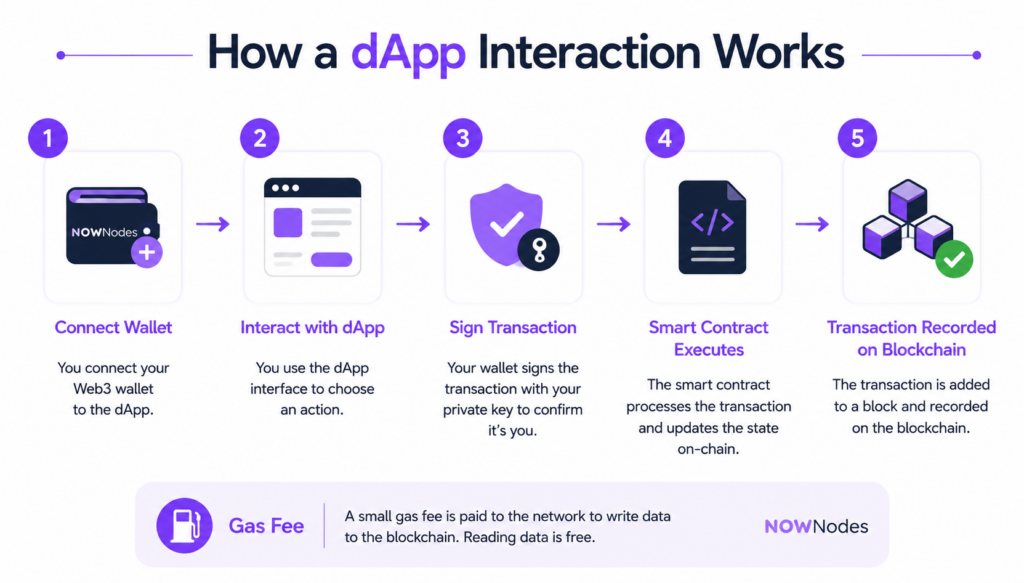
Under the hood, a dApp is built from three layers working together. Understanding the dApp architecture is the difference between treating dApps as magic and actually knowing what happens when you click “confirm.”
The Blockchain (The Backend)
The bottom layer is the blockchain itself — a distributed ledger maintained by thousands of independent computers rather than one company’s database. Every transaction is recorded publicly and can’t be edited after the fact. This is what gives a dApp its transparency, and it removes the single point of failure that centralized apps have.
Because the ledger is shared and replicated across many machines, there’s no admin who can reach in and change a balance or delete a record. That property is the whole foundation; everything above it inherits this trust model.
The Smart Contracts (The Logic)
The middle layer is where the dApp’s rules live. A smart contract spells out exactly what the dApp does — how a token swap executes, how interest accrues on a loan, how an NFT transfers owners. Any time you do something in a dApp, you’re really just triggering functions inside these contracts.
The catch developers live with: once a contract is deployed, it generally can’t be patched. A bug ships permanently unless the contract was specifically designed to be upgradeable. That’s why careful design and independent audits matter so much — a point we’ll return to in the security section.
The Frontend and Wallet (The Interface)
The top layer is the bit you actually see and tap on, and like I said, it’s built with the same tools as any website. What’s different is logging in. There’s no email-and-password box here. Instead you hook up a Web3 wallet — MetaMask is the one most people start with. Your wallet holds your private keys, and when you do something, it signs the transaction to prove it was really you. No personal details get handed off to a server in the process. (Curious how a wallet actually points to a contract on-chain? NOWNodes’ guide to the BNB Smart Chain contract address breaks down the 0x format that sits behind every dApp interaction.)
In practice the whole dApp flow goes something like: connect wallet, the screen shows you your options, you tap to approve, your wallet signs, and the smart contract does its thing on-chain. Reading info off the blockchain costs nothing. Writing to it — any actual transaction — costs a little gas fee that goes to the network.
Gas fee: what you pay the network to run a transaction or fire off a smart-contract function. The price moves around depending on how heavy the action is and how busy the network happens to be right then.
What Are dApps Built On? Blockchains and Standards
A dApp is really only as good as the chain it sits on. The network you build a dApp on decides what it costs to run, how fast it feels, and how many people can reach it. Ethereum is still the big one here — it’s got the most tools, the most developers, the most of basically everything — but these days it’s far from your only option for building a dApp.
There’s a wave of newer Layer-1 chains — Solana, BNB Chain, Avalanche — that go after speed and cheaper fees. Then you’ve got Layer-2 networks like Arbitrum, Optimism, and Base, which sit on top of Ethereum and borrow its security, but bundle up transactions and settle them back to the main chain so everything’s way cheaper. A lot of teams just start on an L2 now, mostly because building there feels almost exactly like building on Ethereum but costs a sliver of the price. Whatever chain you land on, your dApp still has to talk to that network constantly to do anything useful — which is why plenty of teams lean on Web3 infrastructure for developers instead of babysitting that connection themselves.
There are two terms that explain why dApps play nicely across all these chains:
| Term | What it means |
| EVM | Short for Ethereum Virtual Machine — basically the engine that runs smart contracts. Chains that are “EVM-compatible” can run the exact same contract code, so a dApp can hop between them without much rewriting. |
| Token standard | A common rulebook — ERC-20 for regular tokens, ERC-721 for NFTs — that lets wallets and dApps recognize and deal with any token built to follow it. |
Here’s what that actually buys you. Since so many chains speak EVM and stick to the same token standards, a wallet that works with one dApp tends to work with loads of them, and builders don’t get boxed into one ecosystem. That shared plumbing under everything? It’s a huge reason the whole dApp scene blew up as fast as it did.
Types of dApps
dApps cluster into a handful of categories. Knowing the main types of dApps helps you place any new project you come across — and the market-share figures show where real dApp activity actually concentrates.
DeFi (Decentralized Finance)
A DeFi dApp recreates financial services — lending, borrowing, trading, earning yield — without banks or brokers in the middle. This is the heavyweight category by value: DeFi reached a record $237 billion in total value locked across all chains in Q3 2025, according to DappRadar’s State of the Dapp Industry report. Uniswap (trading) and Aave (lending) are the canonical DeFi dApps.
Gaming and the Metaverse
Here, the in-game stuff you earn is actually yours — it’s minted as NFTs you can sell off outside the game whenever you feel like it. And gaming pulls the biggest crowd of any dApp category, pretty much every quarter. In Q3 2025 it grabbed a 25% slice of all dApp activity — more than any other segment managed. Worth a caveat, though: plenty of “gaming” dApps lean hard on engagement tricks rather than being games anyone actually plays for fun.
NFT Marketplaces
Think OpenSea — dApps where you mint, buy, and sell NFTs: art, collectibles, domain names, whatever. And don’t let the quieter headlines fool you. NFT trading roughly doubled in Q3 2025, landing at $1.58 billion, and a record 18.1 million NFTs changed hands over those three months. This corner of the market isn’t going anywhere.
Social and Identity
dApps such as Lens Protocol let users own their social graph — followers and content travel with them between apps, rather than being locked inside one company’s platform. A dApp like that turns the usual social-media data grab on its head.
DAOs (Decentralized Autonomous Organizations)
Here, the people holding the tokens vote right on-chain to run things — what the fees are, where the money goes, which upgrades ship — with no boss or management team sitting in the middle. Plenty of dApps are run this way, at least partly, by a DAO.
How Are dApps Used Outside Crypto?
This is the part that’s changed most recently, and it’s where the instinct to look beyond crypto pays off. For years dApps served a narrow, crypto-native audience. In 2026 these decentralized apps are increasingly being deployed to solve ordinary operational problems — and the reason isn’t ideology, it’s auditability and the removal of reconciliation overhead between parties who don’t fully trust each other.
A few areas where this is already real:
- Supply chain and provenance. A dApp running on a tamper-resistant ledger can track goods from origin to shelf. Walmart famously uses IBM’s Hyperledger Fabric to trace produce in seconds instead of days, and VeChain does similar work for luxury and agricultural goods.
- Healthcare records. Distributed ledgers let patients control encrypted access to their medical history across providers, reducing duplication while preserving privacy — the model behind research projects like MIT’s MedRec.
- Digital identity and security. Decentralized identity (DID) lets you prove a fact — that you’re over 18, or a resident of a country — using zero-knowledge proofs, without exposing your full personal data. Platforms like Civic let users complete KYC once and reuse a verifiable credential, cutting both friction and the breach risk of repeated data handling.
- Real-world asset tokenization. Traditional institutions are putting assets on-chain: BlackRock’s tokenized BUIDL fund crossed $500 million, and Franklin Templeton runs a money-market fund on-chain.
Decentralized identity (DID): an approach to identity where you hold and control your own verifiable credentials, proving claims about yourself without relying on a central database that stores all your data.
The common thread across these examples is that decentralization isn’t the selling point — verifiable, programmable, shared record-keeping is. When several parties need one trustworthy version of the truth, a dApp can replace a pile of manual reconciliation. That’s a very different pitch from “free money,” and it’s why enterprise interest in dApps is finally translating into deployments rather than pilots.
A Quick Look at How a dApp Is Built
You don’t need to be a developer to follow the shape of this, and seeing it demystifies the whole thing. Building a dApp generally means three pieces of work that map onto the three layers above.
First, you write the smart contract — the dApp’s backend logic — typically in Solidity, Ethereum’s most popular contract language (Vyper is a Python-flavored alternative). Second, you test and deploy it to a network; developers test on a free test network first so bugs don’t cost real money. Third, you build the frontend and connect it to the contract using a library like Ethers.js, with a wallet such as MetaMask handling user sign-in and transaction signing. For a concrete, chain-specific walkthrough of these steps, NOWNodes’ tutorial on how to build a dApp on Tron follows the full cycle from writing the contract to testing it in the browser.
The genuinely hard part of dApp development isn’t writing the first version — it’s security, and the wallet-to-chain connection that sits at the center of it. Because a deployed contract usually can’t be patched, the code has to be right before it ships, which is why audits exist as their own industry. The frontend also needs a stable link to the network so balances and transactions stay accurate; teams building consumer dApps often use dedicated infrastructure for Web3 wallets to keep that experience reliable. If you want to go hands-on, Ethereum’s documentation links to beginner tools like Scaffold-ETH that let you experiment with a working contract and frontend together.
Are They Safe? Benefits and Risks
The honest answer has two sides, and treating either one as the whole story is how people get hurt. A dApp offers real structural advantages over centralized software — and real, specific risks that don’t exist in a normal app.
On the benefit side, three properties stand out. Censorship resistance: no single entity can unilaterally block you or shut the dApp down while the blockchain runs. Zero downtime: with thousands of nodes keeping the network alive, a dApp has no central server that can crash. User control: you hold your own assets and connect with a wallet instead of surrendering personal data to a company.
The risks are just as concrete:
- Smart-contract bugs. Immutable code means a flaw can’t be easily fixed, and attackers actively hunt for them. Smart-contract vulnerabilities contributed to over $263 million in stolen assets in 2025, with access-control flaws alone accounting for 59% of DeFi hack losses that year.
- No safety net. There’s no bank to reverse a fraudulent transaction or a support line to recover a lost seed phrase. If you sign a malicious transaction or lose your keys, the funds are usually gone for good.
- Scalability and cost. When a network gets busy, transactions slow down and gas fees spike.
- Phishing and fake frontends. Scammers clone popular dApp websites to trick you into approving wallet-draining transactions. The defense is boring but effective: reach a dApp through a bookmarked, verified URL — never a random ad or DM — and read what your wallet asks you to sign before confirming.
The takeaway isn’t “avoid dApps.” It’s that the trust model moves to you. That’s empowering and unforgiving in equal measure, which is exactly why understanding the mechanics above matters before you connect a wallet to any dApp.
Tokens Worth Knowing
Many established dApps have a native token used for governance, fees, or incentives — holding one often means a say in how the dApp is run. The list below covers widely-used, well-established dApp tokens across the main categories.
A necessary caveat: token prices and market caps move constantly, so the figures below are approximate snapshots from mid-2026 and should be verified on a live tracker like CoinMarketCap before you act on them. This is informational, not investment advice.
| Token | dApp / Protocol | Category | What the token is for |
| UNI | Uniswap | DeFi — DEX | Governance of the largest decentralized exchange |
| AAVE | Aave | DeFi — Lending | Governance and staking in a major lending protocol |
| LINK | Chainlink | Oracle infrastructure | Paying for the off-chain data feeds that power other dApps |
| LDO | Lido | DeFi — Liquid staking | Governance of the leading liquid-staking protocol |
| MKR / SKY | MakerDAO / Sky | DeFi — Stablecoin | Governing the protocol behind the DAI stablecoin |
| CRV | Curve | DeFi — Stablecoin DEX | Governance and incentives for low-slippage stablecoin trading |
| HYPE | Hyperliquid | DeFi — Derivatives | Native token of a high-performance on-chain derivatives exchange |
For scale: among the big DeFi dApp tokens in 2026, Chainlink has held a market cap up in the multi-billion-dollar range, while Aave saw double-digit weekly gains during periods of rising lending demand — a reminder of how much these values swing. Always check current data.
One important note on what a token does not guarantee. A governance token gives you a vote and sometimes a share of fees; it doesn’t make a dApp safe or successful. Plenty of tokens exist for dApps that never gained traction. Judge the dApp on its usage, audits, and track record first — the token is downstream of that.
Conclusion
Boil it all down and a dApp comes back to one thing: an app that runs its backend on a blockchain instead of a company’s servers. That single switch is what hands you the transparency, the censorship resistance, the control over your own data. The plumbing is three layers — blockchain, smart contracts, a wallet-connected front end — the logic sits in smart contracts nobody can quietly rewrite, and just about everything in today’s dApp world traces back to Ethereum flipping the switch in 2015.
The space is also maturing past pure speculation. With DeFi alone holding $237 billion in value and enterprises using dApps for supply chains, healthcare, and identity, the technology is moving from crypto-native novelty toward genuine infrastructure. As DappRadar researcher Robert Hoogendoorn observed of the current moment, “the rise of stablecoins is really pushing DeFi into the spotlight of traditional finance” — a sign of where the next wave of adoption is heading.
If you take one thing away, make it this: the trust model shifts to you. That’s the source of both the appeal and the risk. Understand the mechanics, verify before you connect, and treat the token as secondary to the dApp’s actual track record.
FAQ
What’s the difference between a dApp and a regular app?
A regular app runs on servers one company controls, so they can change it, ban you, or switch it off whenever. A dApp runs on a blockchain, so its rules are locked into smart contracts and no single party owns your data. Oh, and with a dApp you log in with a wallet instead of an email and password.
What are dApps actually used for?
Mostly crypto stuff right now — DeFi (lending, trading), NFT marketplaces, blockchain games, and on-chain voting. But it’s spreading. Companies are starting to use dApps for tracking goods through supply chains, handling medical records, digital ID, and putting real-world assets like funds and property on-chain.
What blockchain are dApps built on?
Ethereum’s the classic choice, but it’s not the only one. You’ll also find dApps on other Layer-1 chains like Solana, BNB Chain, and Avalanche, plus Layer-2s like Arbitrum, Optimism, and Base that piggyback on Ethereum’s security but cost a lot less to use. Loads of these are EVM-compatible, meaning the same code runs across them.