
Every time someone swaps a token, mints an NFT, or borrows against their crypto, a piece of software runs the code that makes it happen. That software is the Ethereum Virtual Machine — the EVM. It’s the engine underneath Ethereum, and, as it turns out, underneath most of Web3.
Here’s the part that surprises people: the EVM isn’t unique to Ethereum anymore. Dozens of other blockchains run the exact same engine, which is why a wallet like MetaMask works across so many networks and why developers can ship one app to several chains at once.
Consider this the EVM explained from the ground up — what the Ethereum Virtual Machine is, how it actually works under the hood, what “EVM compatible” means, and where the technology is heading in 2026. No prior blockchain engineering required.
What Is the Ethereum Virtual Machine?
Let’s start with the simplest possible answer. The EVM is the runtime environment that executes smart contracts on Ethereum. Every node in the network runs its own copy, and they all reach the same result from the same input — that agreement is what keeps the blockchain trustworthy.
EVM or Ethereum Virtual Machine is the shared execution environment that every Ethereum node runs to process smart contracts, with “gas” metering the computational effort of each operation. (Definition adapted from ethereum.org.)
Two words in that definition do the heavy lifting: decentralized and identical. No single company owns the EVM or runs it on a private server. Instead, it lives on thousands of machines worldwide, each executing the same instructions and checking each other’s work.
The World Computer, Minus the Metaphor
People often call Ethereum a “world computer,” and the EVM is the reason the phrase fits. Rather than a distributed ledger that only tracks balances — the way Bitcoin does — Ethereum behaves like a distributed state machine. It holds the current state of every account and contract, then updates that state block by block according to fixed rules.
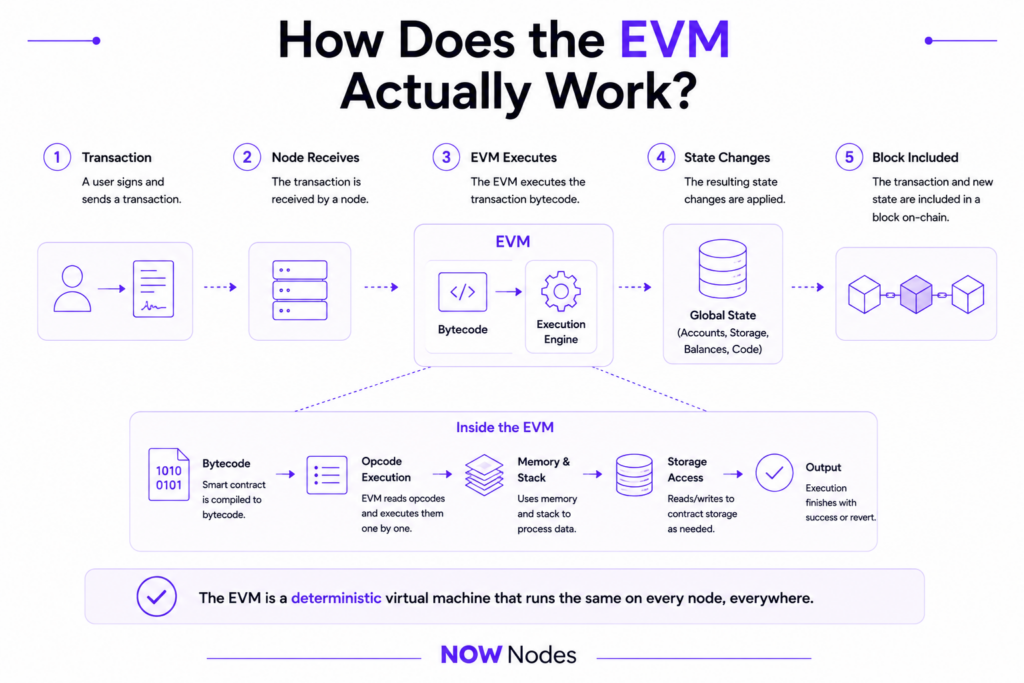
The key property is determinism. Give the EVM the same starting state and the same transaction, and it always produces the same output — on every node, every time. This is critical: without it, nodes couldn’t agree on what happened, and the whole network would fall apart.
Why do those thousands of machines stay in sync? Because they all follow one formal specification — the Ethereum Yellow Paper, first written by co-founder Gavin Wood. A contract behaves the same no matter whose software runs it.
Why the EVM Had to Exist
Bitcoin proved you could move money without a bank. But its scripting was deliberately limited — great for payments, useless for building an app. Ethereum’s founders wanted something programmable: a platform where code, not a company, enforces the rules.
That’s the gap the EVM fills. When Ethereum launched its mainnet on July 30, 2015, it shipped with a virtual machine that could run arbitrary logic — self-executing programs called smart contracts — in a safe, shared, predictable environment. Everything that followed, from DeFi to NFTs to DAOs, was built on that foundation.
How Does the EVM Actually Work?
You don’t need to read bytecode to use Ethereum, but knowing the pipeline makes everything else click. The journey from a developer’s code to a permanent change on the blockchain runs through three stages: compilation, execution, and metering.
From Solidity to Bytecode
Developers don’t write directly for the EVM. They write in a high-level language — usually Solidity, sometimes Vyper — that reads a bit like JavaScript. A compiler then turns that human-readable code into bytecode, the low-level format the EVM actually runs.
That bytecode is a sequence of opcodes (operation codes) — small, fixed instructions like “add these two numbers” or “store this value.” The virtual machine understands a limited set of around 150 of them. Keeping the instruction set small and predictable is a design choice: fewer operations means the code is easier to audit and less likely to hide nasty surprises.
Opcode is a single low-level instruction the EVM can execute directly — adding numbers, reading storage, hashing data. Every contract compiles down to a string of these.
The Stack, Memory, and State
Internally, the EVM is a stack machine. It works through a stack that holds up to 1,024 items, where each item is a 256-bit word — a size chosen to fit the cryptography Ethereum leans on, like Keccak-256 hashing. It’s a deliberately simple model, closer to a pocket calculator’s logic than a modern processor.
Data lives in a few places. Temporary values sit in memory that’s wiped after each transaction, while permanent data — token balances, contract variables — is written to storage and recorded in the network’s state. That persistent state is organized in a structure called a Merkle Patricia Trie, which lets any node verify the data hasn’t been tampered with.
Gas: The EVM’s Metering System
Here’s the mechanism that keeps the whole thing from breaking down. Every operation it performs costs gas, a unit that measures computational effort. You pay for that gas in ETH, and if a transaction runs out of it mid-execution, the transaction reverts — but you still pay for the work already done.
Why bother? Gas solves a classic computer-science trap called the halting problem. Because every step costs something, no program can run forever: it either finishes or exhausts its gas budget. That single rule stops spam and infinite loops from clogging the network, and it nudges developers toward writing lean, efficient code.
What Does “EVM Compatible” Mean?
Now for the idea that turned the EVM from an Ethereum feature into an industry standard. A blockchain is EVM compatible when it can run the same bytecode and smart contracts that Ethereum runs. Speak the EVM’s language, and you plug into everything built for it.
The payoff is enormous. A team that built a DeFi protocol on Ethereum can deploy it on an EVM-compatible chain with little to no rewriting — same contracts, same tooling, a fraction of the effort. For users, it means one wallet works nearly everywhere.
Why Compatibility Became a Superpower
The real advantage isn’t the engine — it’s the ecosystem stacked on top of it. Developers building for any EVM chain reuse a mature toolkit: Hardhat and Foundry for development, ethers.js for connecting apps, MetaMask for wallets, and a decade’s worth of audited, battle-tested contract libraries.
That shared foundation compounds. Every new EVM compatible blockchain inherits thousands of existing apps, familiar developer workflows, and a talent pool that already knows the tools. Starting from scratch on a non-EVM chain means rebuilding all of that — which is exactly why so few try.
EVM-Compatible Blockchains: Who Uses It in 2026
The EVM isn’t a niche standard. It’s the default execution layer across a huge swath of the market, spanning Ethereum itself, its Layer 2 networks, and a tier of independent Layer 1 chains. As of mid-2026, Ethereum plus its Layer 2s command roughly two-thirds of all value locked in DeFi — about 68%, or around $70 billion, according to DeFiLlama.
Here’s how some of the major EVM compatible blockchains stack up:
| Chain | Type | Why It Matters in 2026 |
|---|---|---|
| Ethereum | Layer 1 | Settlement layer for the whole ecosystem; ~$120B TVL and the deepest audited-contract library |
| Arbitrum | Layer 2 | Deepest L2 DeFi liquidity, ~$13.8B TVL |
| Base | Layer 2 | Fastest-growing L2 by users, ~$11.2B TVL, built by Coinbase |
| BNB Smart Chain | Layer 1 | High-volume, low-fee EVM chain popular in retail DeFi |
| Polygon | Layer 2 / sidechain | Long-standing scaling network with broad enterprise adoption |
| Avalanche (C-Chain) | Layer 1 | An EVM environment inside a high-throughput multi-chain system |
TVL figures are snapshots from public analytics in mid-2026 and shift constantly.
Ethereum anchors the group as the settlement layer, where most institutional capital sits, while chains like BNB Smart Chain bring the same EVM to a cheaper, higher-throughput environment. The tooling barely changes when you move between them — that’s the whole point.
Layer 2s: Where the EVM Scales
Most new EVM activity now happens on Layer 2 rollups — networks that process transactions off Ethereum’s base layer, then post compressed data back to it for security. It’s a clever division of labor: you get Ethereum-grade settlement at a fraction of the cost.
The economics shifted hard in March 2024, when Ethereum’s Dencun upgrade (EIP-4844) cut rollup fees by 80–90% almost overnight. Two chains — Arbitrum and Base — now hold roughly 77% of all Layer 2 DeFi value between them, a striking concentration given how many rollups exist. Newer high-performance entrants like Monad push further still, promising full EVM compatibility with parallel execution and far higher throughput.
The EVM’s Limits — and Where It’s Heading
No honest explainer stops at the good parts. The EVM’s greatest strength — every node runs every operation — is also its ceiling. Understanding those trade-offs tells you what Ethereum and its peers are actually racing to fix.
The Known Trade-Offs
Because thousands of nodes re-execute the same computation, the engine prioritizes correctness over raw speed. During busy periods, gas fees spike and complex interactions get expensive. And since contracts compile from only a handful of languages — mainly Solidity and Vyper — developers outside that world face a real learning curve.
Security is the other sharp edge. Smart contracts are hard to change once deployed, so a single bug can mean permanently lost funds. That sandboxed design contains the damage, but it can’t write safe code for you.
The RISC-V Question
The clearest sign of where things are going came in April 2025, when Ethereum co-founder Vitalik Buterin proposed replacing the EVM entirely with a general-purpose architecture called RISC-V. The goal: make the execution layer far easier to verify with zero-knowledge proofs, where the EVM’s design adds enormous overhead.
The numbers are the argument. Buterin estimated the change could improve proving efficiency by 50 to 100 times, and he didn’t hedge about its necessity — calling it “perhaps the only way” to meaningfully simplify Ethereum’s execution layer. Crucially, existing EVM contracts would keep working; developers would still write Solidity, just compiled differently underneath.
This won’t happen overnight. Buterin’s own estimate puts a base-layer migration at 18 months or more, and the community is still debating it. But the direction is already visible: the Layer 2 network Linea plans to deploy RISC-V proving on its mainnet by late 2026. Whatever eventually replaces or augments the EVM, backward compatibility with today’s contracts is treated as non-negotiable.
How to Connect Your App to EVM Chains
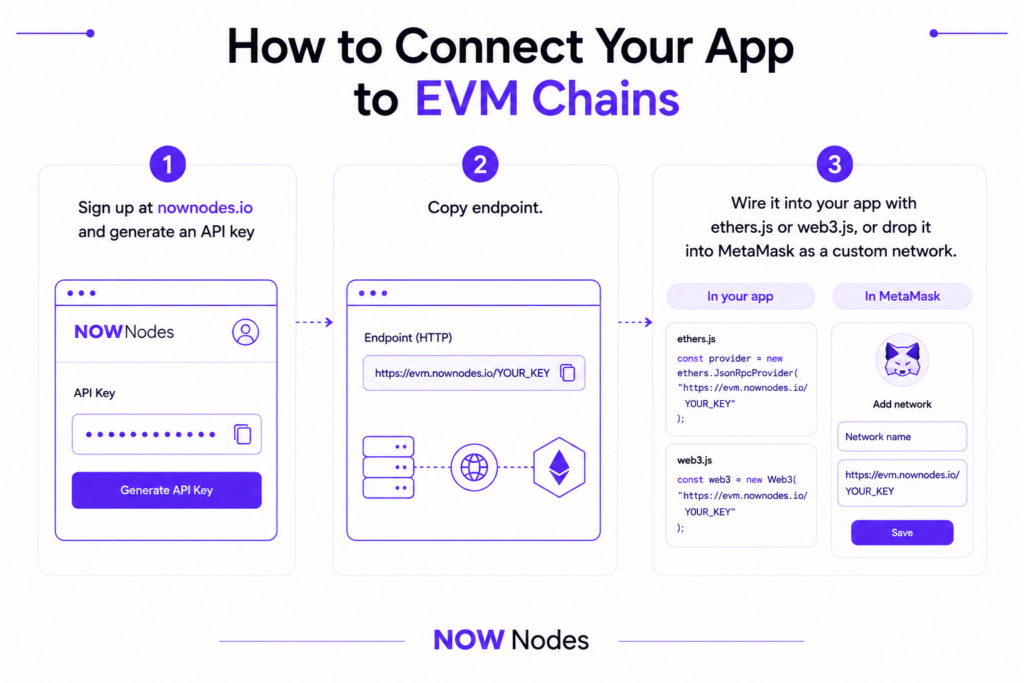
Knowing what the EVM is only gets you so far — at some point your app has to actually talk to the network. It does that through an endpoint: a server that reads the chain’s current state and broadcasts your signed transactions to it. Your wallet, your trading bot, your dashboard all lean on one in the background.
You can run that infrastructure yourself, but it’s a heavy lift — syncing terabytes of data, keeping clients patched, watching uptime around the clock. This is where a provider like NOWNodes earns its keep: you connect to a maintained endpoint instead of babysitting servers.
Here’s the part that ties back to everything above. Because EVM compatible blockchains share the same interface, standard Ethereum methods like eth_getBalance, eth_call, and eth_sendRawTransaction behave identically across them. Point your code at Ethereum today and BNB Smart Chain tomorrow, and the main thing that changes is the endpoint URL.
Getting started takes a few minutes:
- Sign up at nownodes.io and generate an API key from the dashboard. The free START plan covers 100,000 requests a month — plenty for testing and small projects.
- Copy your endpoint. For Ethereum it looks like
https://eth.nownodes.io/your_api_key; for another EVM chain, you swap the subdomain and keep the same key. - Wire it into your app with ethers.js or web3.js, or drop it into MetaMask as a custom network. From there you’re reading balances and sending transactions on-chain.
Beyond the basics, NOWNodes covers Ethereum Mainnet and testnets, WebSocket connections for live data, and archive access for apps that need historical state — and that single key reaches 120+ networks when your product outgrows one chain.
The Bottom Line
Strip away the jargon and the EVM is simple to describe: a shared, deterministic computer that runs the same code the same way across thousands of machines, with gas keeping everyone honest. That design is what makes smart contracts trustworthy — and what let an entire industry standardize on one execution engine.
For anyone building in Web3, that standardization is the real gift. Write for the EVM once, and your app can reach Ethereum, its Layer 2s, and a long list of EVM compatible blockchains, all sharing wallets, tooling, and liquidity. Getting connected is the one piece you still have to nail down — and, as above, NOWNodes handles that side so you can focus on what you’re actually building.
The EVM won’t stay frozen; the RISC-V debate makes that clear. But its core promise — code that executes exactly as written on a network nobody controls — is exactly why it still powers most of Web3.
FAQ
What does “EVM compatible” mean?
An EVM compatible blockchain can run the same smart contracts and bytecode as Ethereum. That lets developers deploy an existing Ethereum app on another chain with minimal changes, and lets users interact with it using familiar wallets like MetaMask.
What is gas in the EVM?
Gas is the unit the EVM uses to measure computational work, paid in ETH. Every operation costs gas, and if a transaction runs out, it reverts. The system prevents spam and infinite loops by ensuring every program eventually stops.
What language are EVM smart contracts written in?
Mostly Solidity, with Vyper as a common alternative. Developers write in these high-level languages, and a compiler converts the code into EVM bytecode — sequences of low-level instructions called opcodes that the EVM executes.